Tuesday, August 21, 2018
Adding Food to Your Novels
As a compiler of cookbooks and a writer of fiction, I like food in my books. When I created the character, Gideon Miller, for my ex-Amish novel, I knew he had to have foods he liked. Since he's from the Amish country of Pennsylvania, apple butter made sense, and so I showed how he spread apple butter on his toast each morning before heading to work at the auto mechanic shop in Twin Branches, North Carolina (don't look for that on the map; I made that town up). I also let him drink green tea, straying a little from the Amish tradition. He did stray after all; he chose to escape their lifestyle and move to the mountains of North Carolina.
I think showing what a character enjoys eating brings out the fun in a book, as well as makes the men and women in the pages seem human. Food connects us in a fabulous way. Perhaps that's why cookbooks with photos of decadent cakes and latticed pies are so popular.
Speaking of human, Still Life in Shadows is now on audio, narrated by a man. You can sit back and relax, eat, bake, drive, or garden while listening to the story of Gideon and how he helps dissatisfied youth leave Amish culture and make their home in the English parts of America. You can hear Kiki, the teen who wants to belong, but due to her autism is often misunderstood. You'll meet Ormond, the auto shop owner, and Mari, who works in a tea room where Gideon goes for tea and pie.
If you'd like to listen to Still Life in Shadows and write a review or post something about the novel on your blog, let me know. I can send you a code to get a free (yes, FREE) audio book.
Simply email me at info@alicewisler.com to get your free audio book! Happy listening!
If you'd like a print or e-book copy, head over here.
Labels:
Alice J. Wisler,
Apple butter,
ex-Amish,
ex-Amish fiction,
inspirational fiction,
Lighthouse Publishing of the Carolinas,
LPC,
Still Life in Shadows
Friday, August 10, 2018
Seeing Your Child's Name
When I showed my friend Jane the plaques we made for her daughter's memorial garden, she loved them. Carl does the work, so I took no credit, except I did screw in the eye hooks and attached the chain to one of them. You would think I was constructing a new house; it took me much longer than it would have taken an average person to do that task of placing the eye hooks, drilling the hole, screwing them in. But enough about my lack of skill and slowness. What impressed me and will stick with me about giving the two garden plaques to Jane was what she said after she said she loved them.
"It's so nice to see her name."
A name. Katelyn. When Katelyn was born, Jane came up with the spelling of the name, so not only was it her daughter's name, Jane had a part in crafting it.
In the bereaved parents' writing workshops I facilitate, I often have parents say their child's name aloud. All together we say our child's name, like one big burst of sunlight. Sometimes we go around the room and take turns saying the name of our child. It's a sacred time.
Whenever we get an order at our shop, Carved By Heart, and the buyer has the name Daniel, I love seeing it on the order form. My heart does a little flip. This customer is special to me because of his name. It doens't matter than I don't know the customer personally, I just love seeing his name. After the item is created and I've wrapped it up, I get to write Daniel on the package. My son's name. My son who is no longer here.
So when Jane ran her fingers over her daughter's engraved name and smiled, it was a powerful moment.
We do need to see and speak our child's name. Often. We don't get to call them to dinner anymore, watch them play, or wrap a gift for them. But we can give ourselves a gift by saying his/her name. Aloud. We can have it engraved into pine and see it, too. Our new butterfly garden plaques are now at our shop on Etsy.
Labels:
bereaved parents,
Carved By Heart,
Etsy,
garden decor,
Garden Plaque,
memorials,
Our child's name,
Personalized garden plaque
Monday, May 7, 2018
Grief as a Gift
It's been 9 years since I wrote the following for the Open to Hope website. Seems so long ago, and yet, just like yesterday. I hope this piece will speak to those of you who are dealing with new grief.
Opening Grief as a Gift
Written by Alice Wisler on Sunday, March 8, 2009
By Alice J. Wisler —
Some view grief as a dirty word.
It’s associated with pain, hardship, suffering, endless days of crying and never seeing the sun. It’s hard – tough on the body, spirit and mind. No one wants to have to go through grief. All hope to avoid it.
The Oxford Dictionary defines “grief” as the media does – intense mourning. I know that’s true because when Daniel first died, the agonizing pain was intense. To walk into a store was painful. Seeing my surviving children and knowing that from now on Daniel would not be with us on earth again crushed every nerve.
But the dictionary, like the media, fails to take the meaning of this word a step further. Grief is defined as though it is a process with an ending. This leads our society to believe that one day, you lose your grief, as you have lost your child. As the years have gone on, I am under the impression that my grief, and that of fellow bereaved parents, will hold no ending. As long as we live on this earth without our children, we will miss them, love them, mourn for what might have been and therefore, grieve.
Granted, grief may not be as intense. For this, we are grateful. If the rest of our lives would entail the fierceness of fresh grief, how could we ever breathe normally again or function as civilized members of society? No one can live on a wild out-of-control roller coaster of emotions for all of life.
Nan Tanner, editor of Inspired to Journal, writes: “I am functioning on my guts right now. Whatever I feel like doing, I do it. I’m in a no-nonsense frame of mind, and I like it. It’s empowering, and I can feel it’s a direct result of loss and grief.”
Tanner, who has suffered the loss of her father, put it quite well. I know that feeling of boldness that new grief can give you. Nan says she feels like steel.
It is amazing to me that while we are crushed by grief, we are also empowered by how it can make us determined to stand up more for what we believe in, not take any slack from anyone and be in that no-nonsense frame of mind.
Is this a gift? Could it be that grief, with its endless component, is really a gift to be opened and dealt with, and used for our benefit?
Recently, just before Daniel’s would-be-tenth-birthday, a college friend who knows that since Daniel’s death I have collected watermelon objects, sent a box filled with dishes and other items – all with the red, green and white motif. Being able to cry when I opened my watermelon package was a gift. Writing a poem later that week in memory of Daniel and using the watermelon theme, was an added bonus. Sending the poem to friends and other bereaved parents was a tribute to Daniel. Praise for the poem and remembrances of Daniel were given to me.
People establish funds, scholarships, start newsletters, write books and plant trees – all in honor of some loved one who has died. Mourners put their grief to work in order to honor and carry on the love they hold for the one they can no longer embrace. Grief is not always in the obvious and expected form of tears. Some might think that a person no longer with tears is no longer in grief. Many tears do not reach the eyes but are forever present in the heart.
So what is grief? It is a mixture, a hodge-podge, a collection of emotions that range from one end of the scale of human feelings to the other end. Grief causes us to act and react.
As I listen to the crickets and bullfrogs near Daniel’s memorial tree, I pen some of my thoughts on what grief has been for me:
Grief is laughing with your children and wishing for the absent one to make the circle complete.
Grief is crying in your car at stoplights.
Some days grief makes you brutally honest; other days, grief muzzles you.
Grief reconstructs your heart.
Grief is sadness, hope, smiles and tears – rolled tightly like a snowball.
Grief makes you search past the stars and the moon for Heaven.
Grief strips you of everything you were pretending to be.
Grief gives you new priorities.
Grief opens hidden treasures from deep within your soul.
Grief allows you to empathize more deeply with others who ache.
Grief makes you unapologetically bold.
Grief is a daily companion, best dealt with by admitting you do walk with it, even after all these years.
Grief is the price of love; grief is a gift.
Allow yourself time to listen to the sounds of the night and write what grief is to you.
~ Alice J. Wisler, Daniel's Mom.
Labels:
adapting to life after loss,
Alice J. Wisler,
cancer death,
death of a child,
Grief as a gift,
loss of a child,
Open to Hope
Wednesday, April 25, 2018
Broken People
I wrote the following years ago on my Broken Psalms blog and wanted to share it here.
We are a broken people.
Lots of people don't want to admit to that.
Even those who follow Jesus and have deep faith. They want to prove themselves educated or well-off, or sufficient, their own saviors, their own independent clauses.
When I was little, my line was: "Alice can do it." This meant, step aside, Mommy and Daddy, I can set the table, I can put my own shoes on, and later it evolved to, I can be sufficient. I don't need anyone.
Some of us try to cover ourselves up with accessories and the newest fashion, and fill our minds with an expensive education. There's nothing wrong with looking good or being smart. (I tried it once; it was wonderful!)
But when our pride of what we can do starts to deceive us into thinking we are superior to others or better off or more loved, then we aren't living a life of humility or service. We aren't transparent. We're soaked up with ourselves. We can do it. Alone. Look at us. Like a kid swinging from the top bar of the jungle gym, "See me. I am strong. I don't need you."
Then we fall.
Where is God?
Why do I hurt so much?
What is wrong with me?
"Find rest, O my soul, in God alone. My hope comes from Him." Psalm 62:5.
God alone gives us hope. Nothing else.
In all our pain and struggles, He alone restores us to Him, comforts us, knows us.
We were born broken and we will die broken. There is no complete restoration of us---not the kind that transforms us into independent creatures without a need for The One who gives us the only Hope worth pursuing. We cannot save ourselves. We can't fix ourselves.
But we can accept our limitations. And quit trying to pretend that we are self-sufficient. We need Him. Sometimes I still fight how much I do.
Because inside of me is this little voice that wants to do it on her own.
Find rest, O my soul.
When you reach out to rely on Him, when you hand Him the broken pieces of your life, that's when real living happens.
Labels:
a mother's grief,
Alice J. Wisler,
Broken Psalms,
Enduring Faith,
grief and loss,
Patchwork Quilt blog
Friday, March 9, 2018
Growing into Your Grief: Owning It and Living It
You have to grow into your grief. No one can tell you how to do it.
At first after Daniel died, I was going from one train of thought to another. Is this me? Is this what I believe? Is this what I think? Is this what grief is to me? I wasn’t sure how I was to be as a grieving Christian. Some told me to be happy that Daniel was safe in Heaven with Jesus. Did that phrase comfort me? Others said that our children are only on loan from God. Did that mean I should have realized that my other children could be gone from me at any moment, that they have a Due Back By date stamped on them?
I fluctuated between the ideas and concepts many held at my local chapter of The Compassionate Friends and those of the church. Sometimes these concepts about God were at odds: God didn’t allow Daniel to die; it was a work of the Devil. God allows bad things to happen. God has our days numbered. God has no control over when a person dies. God does not take away our suffering, but he walks with us in it.
As I tumbled into grief’s pit, all of these concepts/truths/thoughts/ponderings made me dizzy.
What did I believe? What did I need in order to make sense of Daniel’s death and get through the muddling? And the most daunting question: Who was I now?
Over the years, you grow into grief, like a new skin. At first, you don’t know where you stand or how to adjust to the “skin” until time passes—time where you’ve sufficiently grappled. During the grappling stage, your thoughts bounce around: I don’t like this new skin. I want my old life back. Where is God? What will I do? What works for me? Why is this skin so itchy? I miss my child.
It’s a time of insecurity, this early grief. But then, you slowly come into knowing who you are—who you have become, shaped by grief. You know which platitudes bug you and why they do. You understand that half of the things society says about moving on are just to make others feel comfortable in their discomfort. People are scared and trying to make sense out of your tragedy. You represent to them that not only did your child die, but that theirs can, too. Quickly, or from an illness that goes on for months. You recognize when you need to leave a function because you’re tired of superficial conversations. You do say your deceased child’s name and don’t feel the need to apologize for bringing up the dead. Or for sharing about the time he slid down the snowy bank in a recycle bin.
Over the years, you have worked hard. Now you have a time-tested grief. You own it. You know exactly what this grief is because it is part of you. You don’t settle for what others expect grief to be for you. If you want to go to the cemetery and lift balloons to Heaven, you do it. You make no excuses. You live your grief out loud in its fullest which sounds ironic and crazy, but that’s how grief has to be lived.
You know that when a school shooting happens and the news anchor says two days later, “They are still grieving,” that he doesn’t get it. Because any parent who wears the itchy skin of grief knows that using the word still is almost laughable. Still grieving after two days, really? You want to be that news anchor for a moment and tell the viewers this: These students, teachers and parents will grieve these losses for the rest of their lives. They have just begun the journey of growing into grief.
Friday, December 29, 2017
Flowers to the Grave
[I wrote this in November, but got side-tracked and am just tweaking and posting it today.]
When you make the second turn down the short road, you see a sign that reads: Low/Soft Shoulder. Just like every journey to the cemetery, a soft shoulder is needed. When you go a bit further another sign greets you: No Outlet. I’m not sure if the sign is referring to the dead or to the rest of us.
The cemetery is Daniel’s Place, named by my children twenty years ago. On this late autumn morning, the sun casts gentle shadows across my son’s small marble marker as the old oak nearby stretches towards Heaven.
When Daniel died at age four after nine months of treatment for cancer (neuroblastoma), I came up with some ideas. First off, I didn’t order a large grave stone. And I didn’t want flower vases. A marker with a built-in vase would mean responsibility and I wasn’t sure I’d be able to visit the grave often enough to replenish the flowers for the vase. Fresh flowers would be best; I wasn’t a fan of plastic ones that faded in the heat of the summer sun. But would I have time (at six months pregnant with a six-year-old and a one-year-old) to buy flowers or pick them from the garden and take them to Daniel's Place? If I had any extra time, I was sure that the rest of society would benefit more if I used it to shower or brush my teeth.
How often was I going to come to this place, remote from the rest of life? I wasn’t going to be one of those Sunday cemetery visitors, heading over after each church service to pay a visit to my son, was I? Besides, I wasn’t sure that this place was going to be one I’d want to visit. Daniel’s memories were at the house where he played with the neighbor kids and his siblings. The garden on the side of our house held the memories of when he picked green tomatoes by the rose bushes. The roses would bloom and be his memorial flowers.
"I'm going to do great things in your memory," I said one March day as the wind made me want to jump into the warmth of my Mom Van, not stand by Daniel's grave. "I'm not sure what I'll do, but it will be great." Oh, the things I would do, could do.
Twenty years later, I have found that the flowers in the grave vases still look fake, staged, and often forlorn.
Also, I have realized that over those years, I still have not done anything great.
But I have learned lessons that only time could have taught me about life and death and the things we do in memory.
We have this continual need to care for our loved ones. We want to do things in their memory. Unlike flowers, our love and our relationship with them does not ever fade and wither. When the living can adorn the grave of their loved ones, that shows another way to say I still love you. I still care. So I bring pinwheels, helium balloons, and solar lights, and yes, even an occasional flower. I write a poem or short story and tuck it away to edit and perhaps, share.
The amazing truth is that over the years, love grows. My love for my living children, husband, and friends has grown.
And my love for Daniel has grown, too. I tell his stories, the silly jokes he recited at age four from a tattered joke book, and watch others smile.
It is love that remains.
And that's a pretty great lesson to have learned.
Saturday, November 18, 2017
Chocolate Fudge from Grandma
The very act of storytelling, of arranging memory and invention according to the structure of the narrative, is by definition holy. We tell stories because we love to entertain and hope to edify. We tell stories because they fill the silence death imposes. We tell stories because they save us. ~ James Carroll
My grandma Stubbs (Dad's mom) brought the chocolate fudge. Arriving at our apartment (when we were in America on furlough in Richmond, Virginia) from Baltimore, Maryland, the fudge traveled with her in a decorative tin. After dinner, dessert followed, and Mom would open the tin. Inside were chocolate squares, all piled like building blocks. The warm sweet sugary aroma filled the dining room. I'd take a piece, but it was almost too sweet and chocolately for me as a small child.
Eating it now, I feel that I've been invited to the big folks' table. It's no longer too sweet; I can hold my own. A cup of coffee and a piece of decadent fudge, I am ready to tackle the world.
In 2013 when I planned to compile my third cookbook of memories, I asked friends and family for special recipes from those no longer with us. The recipes arrived, each with special stories. There are recipes from those who led long, rich lives, and in memory of those who led rich, but much-too short lives. Dad sent one of Grandma's fudge recipes. The memory he's attached to it shares from his own childhood of growing up in the 1930s.
I made Grandma's fudge this morning. Although the recipe Dad submitted is for peanut butter morsels to be used (I am sure the one for chocolate has to be somewhere in the dozens of index cards he inherited), I substituted chocolate morsels. (I am known for a bit of substitution.) I didn't just make one batch, I made three batches. Hours later the house still smells of chocolate.
Memories Around the Table holds recipes and remembrances of those we love and cherish. By making these recipes, thoughts of our loved ones spring to life in the kitchen, in the dining room, and swell our hearts with memories that no one can steal.
Memories Around the Table is now on sale and available at Etsy. Free shipping within the USA.
Labels:
Alice J. Wisler,
bereavement,
celebrating Christmas,
Memories Around the Table,
recipes for Thanksgiving,
treasured recipes
Wednesday, October 18, 2017
Streusel Coffeecake, time to bake!
As the mornings grow chilly, it's time to slow down, enjoy the fall colors, and warm up. A delicious treat to try this season is a coffeecake. Here's a recipe that is almost sacred, given to me on a note card by a woman I called Aunt Annie. Aunt Annie wasn't a blood-relative, but missionary kids learned to call other missionary parents "aunt" and "uncle" because it was so much less formal than Mr. or Mrs. Most of the time, we knew these missionary aunts and uncles better than our own relatives. Our own relatives were in the U.S. and we saw them sporadically; the missionaries who worked near our parents in Japan, we saw often.
So this is a recipe given to me when I got engaged in Japan back in 1988. It came in a colorful recipe book with handwritten recipes from others who were working in Japan at the time. There are recipes from many kitchens. Over the years, I have gone to this cookbook and not only made the recipes, but have added other recipes to it, ones I've printed off the Internet, ones I've cut out of magazines, ones from cookie exchanges. My Japan Recipe Book is fat now. The Streusel-Filled Coffeecake from Aunt Annie Brady remains one of the originals and one of my favorites.
Aunt Annie's son Bill (who graduated from Canadian Academy in Kobe, Japan the same year I did), says he mixes sour cream with the milk to make the coffeecake more moist. I have yet to try that, but it is an option.
Aunt Annie died last year. A number of those who contributed to the cookbook are also gone. The fond memories of knowing these missionaries and learning from them, live on. Their recipes are treasured remembrances.
The back of the recipe card holds Aunt Annie's suggestion about making a batch of streusel and also a tip about not using all the recipe calls for in one coffeecake. However, I use it all. Having a sweet tooth from early on, my feeling is that one can never have too much streusel.
Happy baking and eating!
Tuesday, September 26, 2017
Cooking With Author Jane Jenkins Herlong
Today my guest is Jane Jenkins Herlong, who has a recipe for cheesy grits made in a rice cooker, as well as a new book out. I grew up in Japan, so I've been eating steamed rice forever, but have yet to make grits in my rice cooker. I might just have to do this as this recipe looks like the kind of southern cuisine I love. For those of you with steamers, I guess you will need to follow Jane's instructions for the bottom portion of your steamer. If made in a rice cooker, there is no need to fill the bottom pot with 1/2 water. Omit that step.
Slap Yo Momma Grits!
You will need a rice steamer.
In the top of the steamer with the bottom of the pot filled 1/2 with water, add one cup of grits and four cups of water.
After 20 minutes, add 8 ounces of cream cheese and a 4 ounces of sharp cheese.
Stir and enjoy!
Now here's a bit about Jane . . .
Jane Jenkins Herlong is a Sirius XM Humorist, Amazon best-selling/award-winning author, professional singer, recording artist and award-winning professional speaker.
A recent inductee into the prestigious Speaker Hall of Fame, Jane is one of the 232 men and women to be awarded this honor including former U.S. President Ronald Reagan and General Colin L. Powell. Jane also has achieved the distinction of Certified Speaker Professional by the National Speakers Association.
Jane’s book, Bury Me with My Pearls is an Amazon Best-Seller and was awarded the Gold Medal in the Illumination Book Awards and Christian Small Publisher Book of the Year. Jane’s newest book is entitled, Rhinestones on My Flip-Flops: Choosing Extravagant Joy in the Midst of Everyday Mess-ups published by the Hachette Book Group.
Her award-winning singing and humor is featured on Sirius XM Radio and Pandora Internet Radio along with Jeff Foxworthy, Ray Romano and Jerry Seinfeld. She criss‐crosses the country sharing her “downhome principles delivered with uptown humor.” Jane has also spoken in New Zealand and Germany and is fluent in four languages: English, Southern, Northern and Lowcountry Gullah (gul‐la).
Jane’s keen sense of humor evolved from being labeled Dyslexic and constantly told, “You can’t do that!” Jane changed the word NO to NEXT and the rest is what dreams are made of. Audiences learn the healing power of humor when handling negative people and circumstances for more productive, positive living. Jane’s life stories and humor leave audiences with the same message she lives- “prove people wrong and laugh while living your dreams.”
With a sense of humor and smart work, Jane traveled from the rows of her family farm to the runway of the Miss America Pageant all the way to performing at Radio City Music Hall. She graduated from college with the highest honors voted by her peers and continued on to graduate school. Her successes continued to pile up from there. Today, Jane travels around the world featured at speaking events in New Zealand and Germany as well as several venues around the United States. Jane has also had the pleasure of sharing the stage with several noteworthy people such as General Colin Powell, Rudolph Giuliana and the late Charlton Heston.
And here's about her newest book . . .
Rhinestones on my Flip-flops offers the message Jane lives by: prove people wrong and laugh while living your dreams.
Has your life ever flipped? The challenge is to not become a flop! Strap on your sandals and let Rhinestones on my Flip-flops deliver joy and laughter in the midst of everyday mess-ups.
Professional Southern humorist and award-winning author Jane Jenkins Herlong uses humor, wisdom, and life stories from iconic biblical women to guide you through the inevitable blunders of life.
Learn from the flip-flops of Deceived Eve, Domestic Diva Martha and Whiny Naomi. Laugh and be inspired by honest (ouch) stories delivered with Jane's sparkling sense of humor. Add in some "rhinestoned" advice from modern Women of Wisdom (WOW). And you will learn how to keep the sparkle and shine on your God-given talents even as you experience life's inevitable flops!
Order a copy of Jane's book from Amazon today.
Labels:
Alice J. Wisler. Alice Wisler,
Christian authors,
grits,
Jane Jenkins Herlong,
Rhinestones on my Flip-Flops
Thursday, September 21, 2017
Still Life is 99 cents today!

So the re-release of Still Life in Shadows is kicking off to a nice start. Today the novel is only 99 cents as an e-book. You can pre-order the print version, it should be out within the week.
I appreciate all who have ordered this novel and hope it will be an enjoyable read as you meet Gideon Miller and Kiki Yanagihara.
Labels:
Alice J. Wisler,
ebookDaily,
Still Life in Shadows
Tuesday, September 12, 2017
The Desire to Find Home
Sometimes things go away. Sometimes they come back after they go away. My novel, Still Life in Shadows, hadn't gone away, I still had print copies of it lining my bookcase, but the publisher decided to no longer publish fiction. So one day this past summer, the rights for my novel were reverted back to me. No more copies of my novel would ever be printed or available as e-books. The novel had the potential to fade away.
Not that the story would ever fade for me. I'd spent a year writing it and my agent at the time had presented it to Moody Publishing. They'd offered me a contract and assigned an editor to me to get my story into the shape it needed to be. How could I have neglected so many grammatical issues? Thankfully, my editor worked diligently to get the manuscript into tip-top shape and the novel was released in 2012.
The inspiration for the story would never fade either. Many years ago, I'd watched a documentary on TV, Amish: Out of Order, and had been intrigued by the main character, Mose Gingerich. Mose had left his Amish roots, found a community to live in, and later helped other dissatisfied Amish youth who had broken away from their Amish homes relocate into modern society. Something stirred in me and I knew I wanted to write a novel, a tale about people leaving one place and finding another place to belong. I knew the concept that lies in this heart of mine----wanting to belong----because as an American missionary kid growing up in Japan, there were plenty of opportunities to feel displaced. Although born and raised in Japan, to the average Japanese I was considered a foreigner; I often felt the isolation. In my own country of citizenship----The United States----there were numerous times that I felt like an outcast, unable to fit in. Over the years, I've had many discussions with fellow missionary kids and missionary adults about home and belonging, feeling lonely, and being misunderstood.
So with that background, I created my characters and told the story from the viewpoint of an ex-Amish man, Gideon, and an autistic teen, Kiki. Both of them have the yearning to find home, to be accepted, to belong. Both show that life on the perimeters can be a struggle.
The great news is that Still Life in Shadows has been re-released by Lighthouse Publishing of the Carolinas (LPC)! Although it has a new cover, the story of seeking community and a place in which to identify is old, one that has continued for generations.
Perhaps, you, too, have been in a situation where you have felt isolated and desired to be accepted.
This story is for you.
"A touching novel about how an embittered man is forced to face the Amish community he ran away from years ago. Told by a 30-year-old auto mechanic and an autistic teenage girl, Alice Wisler's Still Life in Shadows speaks of the complexities of family, of belonging, and the tricky task of forgiving. . ." - Julie L. Cannon, author of Twang
Read more reviews and order your copy here.
Monday, August 21, 2017
Watermelon, Irises, Tomatoes, Geraniums, and a Spider: Does Time Heal Wounds?
In bereavement meetings parents have certain topics that continue to be discussed. One's about time and wounds. A mother who had lost her daughter to a car accident just weeks before my son died, said to the group, "They say that time heals all wounds." She was southern and I couldn't understand if she was saying "all wounds" or "old wounds".
I suppose the question that I wanted to ask was: Does time heal? At all? As the minutes, hours, and days tick away in agony, do all wounds get taken care of, soothed, do the scabs heal, do the ugly scars fade?
As a newly-grieving mom, I knew so little about the journey I had been forced to take, but I did know one thing, and that was that old scars do not fade away. I've had a scar since I was two, a paintbrush I was playing with in the bathtub attacked me and cut the skin near my left eye. My parents wrapped me in a towel, held me while I cried, felt awful, and later would wonder if they should have taken me to get stitches. The blood dried up, and healing started, but that scar is still visible all these years later.
So time doesn't heal old wounds. I suspect that after 54 years, that scar on the corner of my eye has done all the healing it is going to do.
No wonder I resonated with another bereaved mother, a veteran, who at fifteen years since her son took his own life, said to me over lunch one afternoon years ago, "I think I've done all the healing that I'm going to do."
She wasn't giving up on healing or digging a hole and hiding, she was being realistic. There comes a point in the bereaved parent's life when she or he knows that it is not going to get any better than this.
For me, I'm not going to be able to look at the things that remind me of Daniel and not feel that tenderness in my heart. Since his death, two fruits, two flowers, and one spider have kept me in the loop of significant memories. The watermelon, the geranium, the tomato, the iris, and the spider are some of the things that hold powerful remembrances for me. And depending on the time of year (Christmas, Daniel's birthdate in August or death date in February), if I encounter any of these, well, bring on the Puffs.
Society may think time washes it all away like an ocean wave. Build a sand castle at the beach and once the waves knock it down, there is no evidence that a sandcastle once stood in the spot. Many can't believe that after ten, fifteen, or twenty years a mother or father can still feel pain.
But it's not that our desire is to feel pain, it's that we want to remember and since our child is dead, of course, it's always going to make us sad.
When I see a purple iris blooming in my garden, I recall the time Daniel, at age three, couldn't say my name Alice well enough to be understood by strangers and they thought he was saying, "My mommy's name is Iris."
Daniel picked green tomatoes from our garden, even though I told him to wait till they ripened. He took a green tomato to the hospital once and put it on the window sill of his room. He had seen me place green tomatoes on the kitchen window sill at our home, with the hope that the sun would stream in and turn them red.
There are many watermelon stories, including the one where friends brought a watermelon to Daniel when he was in the hospital for chemo treatments on the Fourth of July. He ate a few slices, spit seeds (this was back when all watermelon had "spittable" black seeds), and then said, "I think I've had enough watermelon," and stored the leftovers in the bathtub.
One afternoon I heard Daniel chanting, "A spider, a spider for a pet, a spider for a pet," and when I found him, he was outside watching a tiny spider creep along the side of our house.
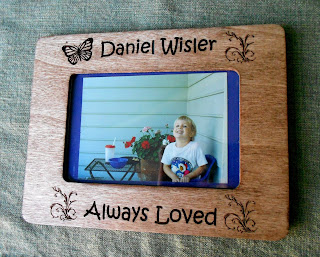
And then the geraniums. I would have forgotten about these flowers (and that apparently I was once able to keep flowers alive) if it weren't for the photo of Daniel seated in his blue plastic chair in front of a table with a cup of juice and a blue bowl of food. He chose to eat his lunch outside beside the potted red, pink, and white geraniums. He would have preferred to be naked if I didn't make him wear clothes. When I took that photo, I had no idea that the neck he exposed so nicely held a malignant tumor, one that would surface months later, and change his life and ours forever.
So does time heal old wounds, or even all of them?
No, and for me, that's a good thing.
[Daniel Paul Wisler, August 25, 1992---February 2, 1997]
Subscribe to:
Posts (Atom)