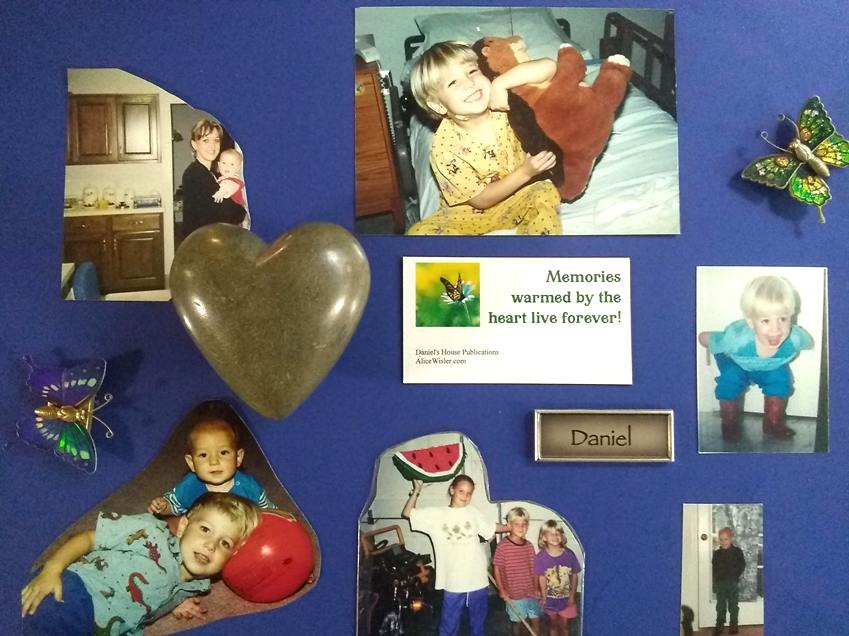
Do you remember when I did Blogtalk radio segments? No? That's okay; it was a while ago. I had about 12 episodes where I spoke on
grief and the bereavement journey.
Now, after much trepidation, I have joined the podcast world. Writing the Heartache is the theme and has
been my push/shove/advice since Daniel died when I realized the wonderful and inexpensive therapy that comes from
writing after loss.
My first podcast (Anchor.FM) is short; it will take just over 5 minutes of your day. The topic is: No Grammar or
Spelling Worries; Just Get it Out There. I share a few benefits of writing from grief.
You can listen by going to the Anchor.FM page. If you don't have a Spotify account (I don't), you can listen by scrolling down the page and pressing the arrow. Go here.
Thursday, August 4, 2022
The Writing the Heartache Podcast has made her debut!
Labels:
Anchor.FM,
bereaved parents,
bereavement,
Christianity,
healing through writing,
No Grammar or Spelling Worries,
Writing the Heartache,
writing to heal
Saturday, July 23, 2022
Good Lists Versus Bad Lists--Steering Toward Peace
I have a penchant for making lists, particularly the to-do and grocery kind. Both help me organize what needs to be done and the grocery one gets me in and out of the store with items I need that without a piece of paper to guide me could easily make me forgetful. Lately I found out that I keep another kind of list, one I have, unfortunately, used many times before. It's one that I store in my mind, one that is a tally of what I’ve done wrong or messed up doing. This type of list leads to regret, remorse, and for an unhappy Saturday (or any day of the week).
Sure, we all have times we make mistakes. Usually we make amends, deal with the consequences, forgive if we need to, and move on. The damage is when we aren’t able to follow these steps and instead of moving on, we take the list in our head---a mental list---with us. The mental list can be degrading and when gone over too many times can cause us to miss out on living life to the fullest. The mental list of negatives is a violent thunderstorm happening in our heads.
Recently I had a mental list going. It started with one disappointment, and another, then it grew larger when I added mistakes I'd made that week, all along telling myself I should have known better. This mental list didn’t grow on its own, I fed and watered it. It became worrisome and caused anxiety. Of course I prayed, asking God to help me. I knew the verses in the book of Philippians that tells us not to be anxious, but nothing seemed to help. I was in a funky state of mind.
After a day of self-induced angst, my eldest daughter Rachel invited me to the beach. She knew nothing of my bad list because I'd shared it with no one. She wanted to spend a day with me and texted that she'd drive. A day at the beach! My heart did a little happy dance. A day at one of my favorite places would be therapeutic. Rachel and I planned, and four days later, we were at Carolina Beach enjoying the sun, the ocean view, salad lunches, seagulls who ventured close, laughter, and being together away from our other lives. We splashed some in the waves, but the wind and current were fierce, so we mostly stuck to the safety of the shore.
When I got home, sunburned and sandy, I was able to think more clearly about mental lists of agony humans bring on themselves. I think we carry these types of lists too long because we don't trust that God does care for us as he tells us that he does in scripture. Instead of carrying petitions before God and allowing ourselves to continue on, trusting him enough to know that he does care deeply for us, we let the mental thunderstorms continue. The beach day was an unexpected blessing from God, a God who saw my needs and mental health when I was at a low point. A God who cared for me and will always care for me.
Sometimes taking a piece of paper and writing my struggles on it and then crumpling it and tossing it into the garbage bin works to show that I will not carry negativity around with me. If only I can remind myself each time I'm tempted to recall those items on the piece of paper I've thrown out that I need to refrain. I have given my problems over to God. No backsies.
I want to free my mind from worry and know that I cannot do it on my own. I will still keep lists to help organize my life, but the lists of tallying up my wrongs are not welcomed. Instead a list of gratitude will be just the thing to steer my mind toward a positive and peaceful direction. I'll end this with one of my all-time favorite scripture verses about God's care and our need to invite the peace he gives--and only he can give--into our minds.
Do not be anxious about anything, but in every situation, by prayer and petition, with thanksgiving, present your requests to God. And the peace of God, which transcends all understanding, will guard your hearts and your minds in Christ Jesus. Finally, brothers and sisters, whatever is true, whatever is noble, whatever is right, whatever is pure, whatever is lovely, whatever is admirable—if anything is excellent or praiseworthy—think about such things. Whatever you have learned or received or heard from me, or seen in me—put it into practice. And the God of peace will be with you. ~ Philippians 4:6-9, NIV
Labels:
Anxiety,
God's peace,
mental lists,
Philippians 4,
trust in God,
worry
Wednesday, June 15, 2022
Cooking With Author Susan G Mathis
Today's treat is a new novel and recipe from author Susan G. Mathis. Susan, welcome! We're glad to have you here to share with us! Take it away.
Traditional Thousand Islands Shore Dinner
Traditionally, the Thousand Islands Shore Dinner a big fishing party. Several skiffs rallied at one island, dispersed to fish until noon, partook of a shore dinner, and then fished again until late afternoon. Fine folk like George Pullman, Frederick Bourne, and J.P. Morgan—and even President Ulysses S. Grant when he visited the islands in 1872— took time to get away from big-city life and find a quiet fishing vacation in the islands. The main boat would often be a small steam yacht. They would leave around 7 a.m., towing up to ten skiffs trailing behind them. The captain would choose an uninhabited island to use for a shore dinner, prepare the meal himself or drop off the meal preparers, and send the fishing guides off to row their guests to different fishing spots.
Around noon, the fishing guides row the guests back to the steamer for a relaxing shore dinner, and then take the fishermen back out for an afternoon of more fishing.
You’ve likely heard of the shore dinners of New England. But the traditional Thousand Islands shore dinners include fresh fish, French toast, and a sandwich with fried pork strips. And, of course, a salad with Thousand Islands Dressing.
Appetizers consisted of fatback and onion sandwiches and a salad with Thousand Islands dressing, of course, and crumbles of fatback. The main meal includes plates of fish and potatoes. And dessert was coffee and French toast.
When they made the camp coffee—they add a cracked egg, shell and all. That way, the grounds stick to the yolk at the bottom of the pot and the shells remove the bitterness. Hmmm…
Then comes the French toast for dessert, also fried in the same pan as the pork and fish, and topped with lots of local maple syrup. Again, one needn’t count the calories; just enjoy the unique flavors of the shore dinner.
Today, uninhabited islands are few and far between, so shore dinners became a little more complicated. But several companies still serve patrons who want a traditional shore dinner. In fact, the NY State parks were, in part, established to provide a place for shore dinners. Maybe one day you, too, can visit the Thousand Islands and enjoy a traditional shore dinner.
Do you think you’d enjoy this meal? In Peyton’s Promise, they served fatback sandwiches to boaters sheltering on Calumet Island. Here’s a recipe for Thousand Islands Dressing!
Thousand Island Dressing
2 cups mayonnaise
1/4 cup ketchup
1 tablespoon onion, finely chopped
1 hard-boiled egg, finely chopped
1 tablespoon green pepper, finely chopped
1 tablespoon red bell pepper, finely chopped
1 tablespoon parsley, finely chopped
1 tablespoon scallions, finely chopped
Mix all ingredients together and chill to blend flavors.
About Peyton's Promise:
Summer 1902
Peyton Quinn is tasked with preparing the grand Calumet Castle ballroom for a spectacular two-hundred-guest summer gala. As she works in a male-dominated position of upholsterer and fights for women’s equality, she’s persecuted for her unorthodox ways. But when her pyrotechnics-engineer father is seriously hurt, she takes over the plans for the fireworks display despite being socially ostracized.
Patrick Taylor, Calumet’s carpenter and Peyton’s childhood chum, hopes to win her heart, but her unconventional undertakings cause a rift. Peyton has to ignore the prejudices and persevere or she could lose her job, forfeit Patrick’s love and respect, and forever become the talk of local gossips.
About Susan:
Susan G Mathis is an international award-winning, multi-published author of stories set in the beautiful Thousand Islands, her childhood stomping ground in upstate NY. Susan has been published more than twenty-five times in full-length novels, novellas, and non-fiction books. She has seven in her fiction line including, The Fabric of Hope: An Irish Family Legacy, Christmas Charity, Katelyn’s Choice, Devyn’s Dilemma, Sara’s Surprise, Reagan’s Reward, and Colleen’s Confession. Her newest, Peyton’s Promise, came out in May 2022 and Rachel’s Reunion releases October 7, 2022. She just finished writing book ten, Mary’s Moment. Her book awards include two Illumination Book Awards, three American Fiction Awards, two Indie Excellence Book Awards, and two Literary Titan Book Awards. Reagan’s Reward is a Selah Awards finalist.
Susan is also a published author of two premarital books, two children’s picture books, stories in a dozen compilations, and hundreds of published articles. Susan makes her home in Colorado Springs and enjoys traveling around the world but returns each summer to enjoy the Thousand Islands. Visit Susan's website for more. And head over to Amazon to get your own copy of Peyton's Promise.
Friday, June 10, 2022
Summer Reading: Novels, Autographed and Ready to Send
Need a book to read this summer?
In an era where print novels are not as readily available as e-book versions, I have three of my novels ready to sign and send to you. That's right, paperbacks, the kind where you can turn and smell the pages. Each price includes shipping to anywhere in the USA. The novels retail for $13.99 and $14.99, but you get to save here.
Rain Song -- My first novel, a Christy-Award Finalist, set in the pickle capital of the world, Mount Olive, North Carolina! Middle-school teacher, Nicole, has a lot of questions about her past in Japan, and a mysterious man enters her life to help her solve them.
How Sweet It Is -- Also, a Chirsty-Award finalist, this one is set in the mountains of North Carolina, where cake decorater Deena, finds herself teaching cooking to some wayward teens per her deceased granddad's request.
A Wedding Invitation -- Samantha gets invited to a wedding where she knows no one. But her mistake leads her to a man from her past who broke her heart, and a Vietnamese girl she taught in a refugee camp.
To order an autographed print novel, select from the Buy Now menu below. Prices include shipping to anywhere in the USA. Or if you'd rather send a check for $15.00 per novel, make it out to Alice Wisler and mail to:
201 Monticello Avenue
Durham, NC 27707
Labels:
A Wedding Invitation,
Alice J. Wisler. Alice Wisler,
fiction,
How Sweet It Is,
inspirational novels,
Rain Song
Saturday, March 12, 2022
Good-bye Malaise; Hello Positive
Malaise --- noun: malaise; plural noun: malaisesa general feeling of discomfort, illness, or uneasiness whose exact cause is difficult to identify.
The year is now is her third month and I realized I haven't posted much on this blog. While I have a hundred excuses, one is that I've started spending time at Medium.com where I got my profile completed and my page up and running. I've been faithfully posting and gaining readership and followers. If you've got a page there, please follow me and I'll reciprocate. Also my happy news is that I've become a writer for Devotable. Devotable publishes devotions, and so far, three of mine have made their debut. So if you'll head over to Medium.com, to see what I've been up to, I'll be happy and grateful.
The truth is, this year I'm all about staying upbeat and grateful. Times are hard. Our country and the world are in sad states. I absorb news to keep informed and sometimes I have to step away and nourish my soul. Instead of letting malaise win me over, I want to look up, be still before God, and write more. I've always believed that writing is healing and healing is what I continue to need.
I hope you'll join me!
Labels:
a writer's life,
Alice J. Wisler,
Devotable,
devotions,
encouragement for writers,
healing through writing,
Malaise,
Medium.com
Saturday, January 22, 2022
Love: Does it End with Death?
I love Daniel.
Daniel’s been gone from Earth for almost 25 years (February 2 is the day he died). Over the years I’ve discovered a multitude of things about grief, about my grieving self— guilt, longing, the lonely hour of 3 AM—and about the way society handles loss.
After a loved one dies, we tend to use the past tense. Instead of I love Daniel, the acceptable thing to say is I loved Daniel. Since Daniel is not living any more, society speaks of him in the past tense. All of the characteristics of him are spoken in past tense, too. Daniel liked to collect stickers; Daniel’s favorite movie was Toy Story, the very first one. He recited jokes from a weathered joke book. He fought bedtime. He had a mischievous smile, especially on the day he went into my desk drawer, took out a self-inking Thank You stamp, and stamped his legs with it.
I know Daniel died. I was there when it happened. I’m not delusional about things, except for when it comes to algebra because that has never made sense to me. I believe that when Daniel took his last earthly breath, his soul arrived in Heaven. He is now in the presence of Jesus, his Savior, whom he learned about in church and through Bible stories from an illustrated book. Daniel still exists; he’s just doesn’t exist here on Earth anymore, except for in our memories.
I loved him while he was my son, for those four short years that I was privileged to be his mama. I still love him, as I love my three adult children who live close by. My love for Daniel has not stopped just because he isn’t with us and I can’t see him open a birthday gift or eat the grilled cheese sandwiches he was fond of enjoying or get his photo taken by the Christmas tree.
I love Daniel. I’ll say it again. I love Daniel. And I invite you to use the present tense when you are talking about the love you hold for your loved one that has passed onto the heavenly eternal.
Even death cannot end the love we have. We don't stop loving a person just because he or she is gone. Love goes on.
Labels:
a mother's grief,
Alice J. Wisler,
Daniel Paul Wisler,
God's love,
Heaven,
love and loss,
our eternal home
Monday, January 10, 2022
Pockets of Grief
Grief comes unexpectedly. Most of us recognize this. But sometimes for those of us who are seasoned grievers, we are surprised when the pockets of grief fill. We think we have control over our feelings of longing and yearning for a loved one who had died.
The Christmas tree was up, bright decorations sat on the coffee table, and some hung from shelves. Christmas tunes played as I prepared for our family's Christmas Eve gathering. I put plates of cookies, dates, and cheese on the dining room table.
Then why did a sudden deep sadness fill the kitchen? I felt like my bones had been carved out and sorrow had been pushed into them. This is a cheerful season, I thought. What's wrong with me?
When my son Daniel first died, Christmases were nearly impossible to celebrate. My husband and I took our three young children someplace away from our home so that we did not have to be in the very house where Daniel was missing. The absence of our four-year-old was too much to handle during a time of festivities. I wanted to be able to close my eyes the week before Christmas and not have to deal with any of the celebrations until the week after the new year. But we know that's not possible, and so like other grievers, others who have had to bury a child, I had to learn how to adapt and adjust to the holidays.
It's been 24 years since Daniel's death. So no wonder I was surprised this past Christmas season when I felt overwhelmed with emotion.
Fortunately I had two bereaved parents, friends of mine, to text. I sent each of them separate text messages. They assured me that my grieving was normal. “Accept yourself in your beauty and brokenness,” wrote one.
I know that many people feel discouraged and depressed around the holidays, and that we need to be mindful of the fact that others around us are lonely and aching. Just because they are cheery decorations, family and friends, and even Christmas songs and hymns that speak of joy, doesn’t mean that all feels well.
In this new year you may have moments of sorrow. Don't deny them, acknowledge them. I find that writing helps. A journal or just any old slip of paper and a trusty, comfortable pen are great tools to use as you spend time writing. Write from your pain. Share a happy memory about your loved one. See what develops.
And one more bit of advice that I like to give, advice that has helped me, be sure to buy sturdy and soft tissues. Because when the tears come, our eyes deserve the best.
Grieving the loss of a loved one never leaves. Even when we think we have the pain tucked away, it can arrive unexpectedly. Don’t run from it; embrace it, if you can. We grieve over a person because we love. What a blessing it is to have had this special person (child, parent, friend, spouse) to love on Earth and to continue to love long after he/she is gone.
Labels:
Alice J. Wisler,
Christmas grief,
grief,
holiday grief,
loss of child
Thursday, October 7, 2021
Every Loss I See
Every death is your death. Every sorrow I come across takes me back. Even the TV moms portrayed as suffering loses of a child cause the wound from your death to ignite. I cry for their loss, their broken story. The actress who does a realistic job of conveying her woe gets more tears from me. I wipe my eyes and think: it never goes away, that ache, that sadness, that loss in losing you, Daniel.
In a recent movie I watched as one of the characters, an older woman, tried to console a young boy of twelve who had lost his baby sister. She said that the child was with Jesus and that Jesus is here. I thought: ah, that's a good way to think. Jesus is with us and he is also with Daniel in Heaven. Jesus bridges the gap between Daniel and me. He is with us both, even if Daniel and I can't be together. As I continued watching the movie, the sweet woman telling that boy to be bolstered by thinking of death in this way made me feel both grateful and sad at the same time.
I suppose that what surprises me most is that even after 24 years I still shed tears unexpectedly.
Every loss I see, every loss I hear, takes me to that place that never fades.
I miss you, Daniel.
I suppose that what surprises me most is that even after 24 years I still shed tears unexpectedly.
Every loss I see, every loss I hear, takes me to that place that never fades.
I miss you, Daniel.
Thursday, August 26, 2021
Lessons from a Balloon-sending Mama
On your 29th birthday, I make my pilgrimage to the grave. Carl parks the Jeep and at your marker, I wipe away the brittle patch of cut dried grass. There's a strip of blue painter's tape stuck to the side. It's in Rachel's handwriting. We love you, Daniel. You've inspired so many people. I take a photo of your oldest sister's note and smile, sending a text to her so that she can see my appreciation.
I put a bunch of red Dollar Store Gerber daisies in the dirt by your marker. They aren't my favorite color Gerbers, but they were the best looking plastic flowers the store had. I take another photo of your grave and wish I could take a photo of you instead. I probably have the largest collection of grave marker photos that any mother has ever accumulated. They span my life over the last twenty-four years since you left us.
I walk over to Solomon's grave. When I found his marker years ago, I shed tears. From II Timothy 4:7 the words are enscribed: I have finished my course. I have kept the faith. If the day wasn't so hot, I would amble over the grass to visit Taylor's grave because his is one that also has touched my heart. We're so glad you came. Beside your grave is Audrey, who has only the year enscribed on her marker. And a large heart. I assume she, like Taylor, died the day she was born.
Under the shade of a tree, I sit on your Thomas the Tank Engine towel and pour into a cup orange-grapefruit seltzer water. The liquid is welcomed. I had planned to stay a longer time seated on the towel, coming up with something profound to write. But the afternoon is hot and humid. The dashboard of the Jeep, says it's 97 degrees F. Carl sits in the Jeep because it's cooler there.
I come to the cemetery with rituals that I have gathered over the years since you've been gone. One is to walk the premise. I have a pair of new tennis shoes on this afternoon. What better place and day to break them in. Briskly I make the round, and am grateful for a breeze. I remember when this location made me feel shame for not having been able to keep you alive. I never expected to have grown from my visits here. I never knew solace at my son's grave was possible. The years have been hard; the journey filled with sadness, but the lessons I have acquired are nothing short of priceless.
After my lap, I write a note to you on a slip of paper. It is my usual note about loving and missing you. On the back of it, Carl writes some words. I peek to see he has written. His words are: Too bad I never got to meet you. He has drawn a heart and signed his name. The love he shows for me by coming with me on this cemetery pilgrimage shouldn't be overlooked.
Inside the Jeep, together we string the note (I've punched a hole in the sheet with a pen) to another Dollar Store purchase----a red star balloon filled with helium.
And then we walk to the center of the cemetery as I hold tightly to the string. "Happy birthday, Daniel," we both say. I release the string which allows for the balloon to jet away from me and climb into the sky. We stand watching the wind do its part as the baloon travels. Soon it's blocked by two large oaks. Carl steps to the left and I follow so that we have a better view. We watch, eyes shielded from the August sun, until the balloon becomes a dot and then vanishes from our sight into a distant cloud.
Twenty-four years of lifting balloons into the sky, my symbolism of releasing love, of watching something perform what I cannot---an item sail into the sky on its own, climbing closer to Heaven. Twenty-four years of an ache that will not leave. I love you, Daniel. My love for family and friends has grown over these long years, so it makes sense that the love for you has increased also. I love you today and I will love you more tomorrow.
And those are a few of the lessons that grief has taught me.
Labels:
a mother's grief,
Alice J. Wisler,
balloons to Heaven,
Daniel Paul Wisler,
his birthday without him,
loss of loved one
Thursday, July 29, 2021
Cooking with Author Lori Altebaumer
Today we welcome author Lori Altebaumer to the blog. Lori has a romantic suspense novel and a recipe to share. SO glad to have you here, Lori! Take it away!
Peg’s Pecan Pie
(From my romantic suspense novel A Firm Place to Stand)
1/2 cup butter, melted
1 cup sugar
1 cup light corn syrup
4 eggs, beaten
1 teaspoon vanilla extract
1/4 teaspoon salt
1 unbaked 9-inch pastry shell
1 – 1 1/4 cups pecan halves
Combine butter, sugar, and corn syrup; cook over low heat, stirring constantly until sugar dissolves. Let cool slightly. Add eggs, vanilla, and salt to mixture; mix well.
Pour filling into unbaked pastry shell, top with pecan halves. Bake at 325 degrees for 50 – 55 minutes. Serve warm or cold. Peg’s hints for a delicious pie: Use eggs at room temperature for better blending. And use chopped pecans to squeeze even more nuttiness into each bite. About the novel
She’s either being stalked or losing her mind.
A job at a camp in the rustic and often rugged landscape of West Texas offers Maribel Montgomery a chance to escape both, especially if she makes sure no one knows where she’s there.
But when the body of a woman washes up in the river on her first morning, her hope of a safe place to start over are swept away. The suspicion she’s being watched follows her to her new home, and Maribel is forced to take a stand or keep running. Does she have the courage to face the danger stirring at the Pool of Siloam Camp?
If she doesn’t, another girl might die.
If she tries and fails, it could be her.
Circumstances force her into the acquaintance of Conner Pierce—a man with secrets of his own. Can Maribel risk working with him in order to save the next victim and find a missing girl?
Or is he the killer?
Get your copy of A Firm Place to Stand.
Author Bio
A life-long Texan, Lori lives in a small community not far from the rugged West Texas landscape she loves to write about. The mother of now grown twins, she has learned the secret to survival is a well-developed sense of humor and an active prayer life. After years spent working in the business world, Lori now uses her time to educate, inspire, encourage, and entertain through the written word.
Connect with Lori here:
Website
Facebook
Instagram
Amazon Author Central
Book Bub
Goodreads
Peg’s Pecan Pie
(From my romantic suspense novel A Firm Place to Stand)
1/2 cup butter, melted
1 cup sugar
1 cup light corn syrup
4 eggs, beaten
1 teaspoon vanilla extract
1/4 teaspoon salt
1 unbaked 9-inch pastry shell
1 – 1 1/4 cups pecan halves
Combine butter, sugar, and corn syrup; cook over low heat, stirring constantly until sugar dissolves. Let cool slightly. Add eggs, vanilla, and salt to mixture; mix well.
Pour filling into unbaked pastry shell, top with pecan halves. Bake at 325 degrees for 50 – 55 minutes. Serve warm or cold. Peg’s hints for a delicious pie: Use eggs at room temperature for better blending. And use chopped pecans to squeeze even more nuttiness into each bite. About the novel
She’s either being stalked or losing her mind.
A job at a camp in the rustic and often rugged landscape of West Texas offers Maribel Montgomery a chance to escape both, especially if she makes sure no one knows where she’s there.
But when the body of a woman washes up in the river on her first morning, her hope of a safe place to start over are swept away. The suspicion she’s being watched follows her to her new home, and Maribel is forced to take a stand or keep running. Does she have the courage to face the danger stirring at the Pool of Siloam Camp?
If she doesn’t, another girl might die.
If she tries and fails, it could be her.
Circumstances force her into the acquaintance of Conner Pierce—a man with secrets of his own. Can Maribel risk working with him in order to save the next victim and find a missing girl?
Or is he the killer?
Get your copy of A Firm Place to Stand.
Author Bio
A life-long Texan, Lori lives in a small community not far from the rugged West Texas landscape she loves to write about. The mother of now grown twins, she has learned the secret to survival is a well-developed sense of humor and an active prayer life. After years spent working in the business world, Lori now uses her time to educate, inspire, encourage, and entertain through the written word.
Connect with Lori here:
Website
Amazon Author Central
Book Bub
Goodreads
Labels:
A Firm Place to Stand,
Christian Fiction,
Cooking with authors,
Lori Altebaumer,
novels,
pecan pie
Monday, July 19, 2021
Superpower Levi
He wasn't just any dog; he had a superpower. I was not an animal lover (my husband is) and I thought I could live the rest of my days without a dog. No dog fur to vacuum, no vet bills, and grocery store trips without having to purchase dog chow suited me.
Then along came Levi, a mahogany boxer puppy with white paws who had a penchant for ice cubes. He "sang"—soulful songs—whenever my husband played the harmonica (badly). If anyone peeled an orange, he appeared, begging for a slice. He nuzzled close beside me when I cried over the loss of my brother's dog. He had the ability to look at me with his dark brown eyes as though he could see into my soul.
He discovered what worked and that was to put his head on my lap when the clock chimed 6 PM---—his way of reminding me that it was dinner time. I’d stop what I was doing and fill his bowl as he’d twirl in circles--—his happy dance.
The seizures were the start of his decline; I sat with him on the sofa and doubted I could live without him. He died on a December morning even though I begged him not to leave us. Levi transformed me into an animal lover; that was his superpower. When I met our new puppy for the first time I was able to embrace her without a moment's hesitation. I scooped her into my arms and held her against my heart.
Levi trained me well.
Labels:
Alice J. Wisler,
boxers,
death of a dog,
dogs,
love of a dog
Tuesday, July 13, 2021
Make it Come to Life : Prologue to a memoir
A view from a train window can kick start a fascinating story. Look what it did for Walt Disney. On a journey from Manhattan to Hollywood in 1928, Walt looked out his window as large towns gave way to wheat and corn fields. And there, under an apple tree, Mickey Mouse showed up. Perhaps Mickey waved a white-gloved hand, or maybe he just smiled. Walt captured him on a sketch pad and the stories began. Walt’s gone now, but his cartoon mouse has traveled all over the world and lives forever.
Although I grew up on trains in Osaka, Japan, my creations weren’t the kinds you sketch, but printed words. I looked out the windows and instead of a mouse, four teens appeared on a boat. They needed an ocean to take them to a remote tropical island where they would get lost, build campfires at night, eat mangos the size of footballs, and have fascinating adventures with the natives. I put them in a rowboat (at age eleven I was not the smartest seafarer which meant neither were my characters) and let a storm fester with just enough wind for their vessel to wash against the shoreline of the island. I named the island Blue Hama (I suppose I didn’t have the knack for good names at age eleven either).
Later, when I had crushes on boys with names like Ethan and Harold, I looked out the window as trains took me to and from school, and saw handsome boys on bicycles near parks where they met pretty girls named Belinda, Camithia, and Sylviana. I bought spiral notebooks at the local stationer’s near my home in Awaji, knowing that each notebook would be the place where a best seller would be brought to life and I’d be rich and famous before I turned twenty.
Each train ride from Awaji to Karasuma—the station closest to my international school—took forty-seven minutes. That’s a lot of time to peer out of windows. In the afternoons, the train was less-crowded and when I got to sit down, I lured my characters, bringing them from outside where they began along the tracks, to inside the pages of my notebooks. I gave them words, obstacles to conquer, and lots of love in their hearts.
If Walt and I had ever crossed paths, or if we’d been seated on the same train, he might have used his pencil to draw me as a kid. Two blond ponytails sticking out from just below my ears, plaid skirt, red tights that bagged around my ankles by the time school got out, and a pair of black patent-leather shoes that were magnets for doggy poop. In my hand would be a yellow number 2 pencil sans an eraser on the end because erasers never last the lifetime of pencils. The pencil would be scratching out my messy words (I had what was known back then as sloppy penmanship) over the lined notebook’s pages, and my ears, although not as prominent as Mickey’s, would be stretched to listen for the conductor’s announcement of my train station.
I spent my childhood on trains. And when I wasn’t on one, I was running to catch one or if I missed it, waiting for the next one on the platform.
Every parent has some story they repeat and repeat, passing it onto their offspring. That’s how those tales of suffering get handed down like certain unwanted family heirlooms: “I had to walk to school in the snow.” “I had to walk up hill in the snow both ways.” “I had to walk in the snow both ways with no shoes.” Mine is: “I had to ride the train to school every day for forty-seven minutes. And that was just one way!” And like any other parent, I’m always subject to the indifferent attitudes my children display when my story is told.
When the Amtrak thundered over the track that day in 1996, I no longer rode the train to school. I was a grown woman of 35 with three of my own children. My middle child, Daniel, aged three, was by my side as we watched the silver cars streaked with red, white, and blue. One after another, after another, racing along, going somewhere. We stood, silent, as one does during the singing of the national anthem or during a prayer. The track was just beyond the slide and swings and the shade of the massive oak tree where we’d had a picnic lunch of peanut butter and jelly sandwiches because those are the easiest for moms to make.
The sound of a train has always tugged at the wild hope chord of my heart. A train symbolizes a way toward a happy destination, but more—the actual journey, looking out the window, passing places you’ve never set foot in, capturing vistas that are quaint, majestic, or even spiritual.
Daniel seemed to understand my need for reverence, he paused from playing with Caleb and tickling his baby brother Ben to be captivated with me.
But once the train was out of sight, he left me for the slide. He climbed up the ladder and at the fourth rung, stopped. “Where is the train going?” he asked.
“To the next station.”
But my reply didn’t seem enough for my son. “Where is the next station?”
I know that Moms are supposed to have all the answers, it comes in a kit they hand you at the hospital after delivery, soon after the umbilical cord is cut. Since the park was just miles from the state capital, I offered a guess and said, “Raleigh.”
“The train’s going to Raleigh?”
Why not? “Yeah.”
“Where’s Raleigh?” Daniel asked.
“Oh, about two miles from here.”
Satisfied with my answer, Daniel continued his climb to the top of the slide. From there he lifted a hand from the railing to wave at me. Just as my motherly instincts kicked in, and with them, the familiar phrase that all moms are taught to say, “Be careful!” Daniel said, “Bye, Mommy! I’m going to Raleigh.” And down he slid, his blond hair flying with the speed of an oncoming train. At the base of the slide sat his friend Caleb, whom Daniel managed to only nick with his shoe. “Sorry, Paleb,” Daniel apologized.
Caleb, unalarmed, continued drawing in the sand with two sticks, one in each hand, swirling them around as though stirring a pot of stew.
It was April, a warm and sunny Southern day. Baby Benny played in his stroller, his chubby hands wrapped around a stuffed blue dog, one that Daniel let him borrow. We often came to the IBM Park on clear days because kids and the outdoors are a freeing combination and moms should get away from houses that need cleaning. Everyone is entitled to some kind of liberation. On days when I babysat Caleb so that his mother, Susan, could work on her music duties at our church, he came with us. Susan packed him lunches in brown paper bags—chocolate pudding cups with peel-away lids, fat ham sandwiches, fruit gummies, and homemade cookies.
“You want that? How about this? Paleb, are you gonna eat this?” Daniel would sort through Caleb’s bag, pulling each item out, shaking it in front of his friend’s face, and asking. That which his friend did not want, Daniel, happily indulged.
They tell you in the Mom’s Kit that your children will always prefer the lunch of another child. Something to do with the grass being greener on the other side of the fence, which boils down to other moms are cooler because they know what kids really like. Sometimes, when I encouraged him, Caleb ate his ham sandwiches. Daniel eyed those sandwiches and every bite Caleb took as he solemnly chewed his own peanut butter and jelly. I eyed those sandwiches, too. Mother and son wishing we had a mom like Susan to make us lunch.
About three weeks later, when a train whistle sounded and a freight train clamored past us in the park—oil cars, refrigerated cars, a car with graffiti—Daniel waited until the caboose was only a dot on the landscape. Then, turning to me where I sat on the grass with Benny who was getting sand in between his bare toes, Daniel said, “The train’s going to Raleigh.”
I smiled. “Oh, is it?”
“Yes. Raleigh is the next station.”
Years later—eighteen to be exact—I was seated in my grandma Stubbs’ mauve recliner, one I had inherited after her death. I looked through old photographs, color prints that mark time. It was a parade of matte and glossy visits—Easters with baskets bigger than my children, the Christmas we got the puppy, birthday cakes decorated with thick butter cream icing, our first night in the new house on Monticello—all made their appearances, chronicling the passage of the years. Rachel, Ben and Liz had all walked in and out and back in the new house many times again and again, even the puppy that grew into a senile beagle, made her way through and out the doggie door. But there would be one person who would never walk through the laundry room door inside or out. No one would ever see his smile or hear his laughter. He was gone, and yet he was everywhere. He was in every story we remembered and told.
The afternoon in my living room of remembering gave into the evening. Through the winter stillness, a train whistle sang—low, mellow, permeating the air. I didn’t stand, but my whole being was attentive until the song turned into only a murmur, as I envisioned its journey down the familiar tracks, tracks I could not see, but knew too well.
“Where is it going?”
Oh, Daniel, you know.
“The train’s going to Raleigh.”
And back again. And even beyond. There is so much to be discovered.
The story was already there, I just had to find the best way to make it come to life.
Labels:
a mother's grief,
bereaved parents,
cancer death,
commuter trains,
Daniel Paul Wisler,
Japan,
memoir writing,
Mickey Mouse
Subscribe to:
Posts (Atom)