A view from a train window can kick start a fascinating story. Look what it did for Walt Disney. On a journey from Manhattan to Hollywood in 1928, Walt looked out his window as large towns gave way to wheat and corn fields. And there, under an apple tree, Mickey Mouse showed up. Perhaps Mickey waved a white-gloved hand, or maybe he just smiled. Walt captured him on a sketch pad and the stories began. Walt’s gone now, but his cartoon mouse has traveled all over the world and lives forever.
Although I grew up on trains in Osaka, Japan, my creations weren’t the kinds you sketch, but printed words. I looked out the windows and instead of a mouse, four teens appeared on a boat. They needed an ocean to take them to a remote tropical island where they would get lost, build campfires at night, eat mangos the size of footballs, and have fascinating adventures with the natives. I put them in a rowboat (at age eleven I was not the smartest seafarer which meant neither were my characters) and let a storm fester with just enough wind for their vessel to wash against the shoreline of the island. I named the island Blue Hama (I suppose I didn’t have the knack for good names at age eleven either).
Later, when I had crushes on boys with names like Ethan and Harold, I looked out the window as trains took me to and from school, and saw handsome boys on bicycles near parks where they met pretty girls named Belinda, Camithia, and Sylviana. I bought spiral notebooks at the local stationer’s near my home in Awaji, knowing that each notebook would be the place where a best seller would be brought to life and I’d be rich and famous before I turned twenty.
Each train ride from Awaji to Karasuma—the station closest to my international school—took forty-seven minutes. That’s a lot of time to peer out of windows. In the afternoons, the train was less-crowded and when I got to sit down, I lured my characters, bringing them from outside where they began along the tracks, to inside the pages of my notebooks. I gave them words, obstacles to conquer, and lots of love in their hearts.
If Walt and I had ever crossed paths, or if we’d been seated on the same train, he might have used his pencil to draw me as a kid. Two blond ponytails sticking out from just below my ears, plaid skirt, red tights that bagged around my ankles by the time school got out, and a pair of black patent-leather shoes that were magnets for doggy poop. In my hand would be a yellow number 2 pencil sans an eraser on the end because erasers never last the lifetime of pencils. The pencil would be scratching out my messy words (I had what was known back then as sloppy penmanship) over the lined notebook’s pages, and my ears, although not as prominent as Mickey’s, would be stretched to listen for the conductor’s announcement of my train station.
I spent my childhood on trains. And when I wasn’t on one, I was running to catch one or if I missed it, waiting for the next one on the platform.
Every parent has some story they repeat and repeat, passing it onto their offspring. That’s how those tales of suffering get handed down like certain unwanted family heirlooms: “I had to walk to school in the snow.” “I had to walk up hill in the snow both ways.” “I had to walk in the snow both ways with no shoes.” Mine is: “I had to ride the train to school every day for forty-seven minutes. And that was just one way!” And like any other parent, I’m always subject to the indifferent attitudes my children display when my story is told.
When the Amtrak thundered over the track that day in 1996, I no longer rode the train to school. I was a grown woman of 35 with three of my own children. My middle child, Daniel, aged three, was by my side as we watched the silver cars streaked with red, white, and blue. One after another, after another, racing along, going somewhere. We stood, silent, as one does during the singing of the national anthem or during a prayer. The track was just beyond the slide and swings and the shade of the massive oak tree where we’d had a picnic lunch of peanut butter and jelly sandwiches because those are the easiest for moms to make.
The sound of a train has always tugged at the wild hope chord of my heart. A train symbolizes a way toward a happy destination, but more—the actual journey, looking out the window, passing places you’ve never set foot in, capturing vistas that are quaint, majestic, or even spiritual.
Daniel seemed to understand my need for reverence, he paused from playing with Caleb and tickling his baby brother Ben to be captivated with me.
But once the train was out of sight, he left me for the slide. He climbed up the ladder and at the fourth rung, stopped. “Where is the train going?” he asked.
“To the next station.”
But my reply didn’t seem enough for my son. “Where is the next station?”
I know that Moms are supposed to have all the answers, it comes in a kit they hand you at the hospital after delivery, soon after the umbilical cord is cut. Since the park was just miles from the state capital, I offered a guess and said, “Raleigh.”
“The train’s going to Raleigh?”
Why not? “Yeah.”
“Where’s Raleigh?” Daniel asked.
“Oh, about two miles from here.”
Satisfied with my answer, Daniel continued his climb to the top of the slide. From there he lifted a hand from the railing to wave at me. Just as my motherly instincts kicked in, and with them, the familiar phrase that all moms are taught to say, “Be careful!” Daniel said, “Bye, Mommy! I’m going to Raleigh.” And down he slid, his blond hair flying with the speed of an oncoming train. At the base of the slide sat his friend Caleb, whom Daniel managed to only nick with his shoe. “Sorry, Paleb,” Daniel apologized.
Caleb, unalarmed, continued drawing in the sand with two sticks, one in each hand, swirling them around as though stirring a pot of stew.
It was April, a warm and sunny Southern day. Baby Benny played in his stroller, his chubby hands wrapped around a stuffed blue dog, one that Daniel let him borrow. We often came to the IBM Park on clear days because kids and the outdoors are a freeing combination and moms should get away from houses that need cleaning. Everyone is entitled to some kind of liberation. On days when I babysat Caleb so that his mother, Susan, could work on her music duties at our church, he came with us. Susan packed him lunches in brown paper bags—chocolate pudding cups with peel-away lids, fat ham sandwiches, fruit gummies, and homemade cookies.
“You want that? How about this? Paleb, are you gonna eat this?” Daniel would sort through Caleb’s bag, pulling each item out, shaking it in front of his friend’s face, and asking. That which his friend did not want, Daniel, happily indulged.
They tell you in the Mom’s Kit that your children will always prefer the lunch of another child. Something to do with the grass being greener on the other side of the fence, which boils down to other moms are cooler because they know what kids really like. Sometimes, when I encouraged him, Caleb ate his ham sandwiches. Daniel eyed those sandwiches and every bite Caleb took as he solemnly chewed his own peanut butter and jelly. I eyed those sandwiches, too. Mother and son wishing we had a mom like Susan to make us lunch.
About three weeks later, when a train whistle sounded and a freight train clamored past us in the park—oil cars, refrigerated cars, a car with graffiti—Daniel waited until the caboose was only a dot on the landscape. Then, turning to me where I sat on the grass with Benny who was getting sand in between his bare toes, Daniel said, “The train’s going to Raleigh.”
I smiled. “Oh, is it?”
“Yes. Raleigh is the next station.”
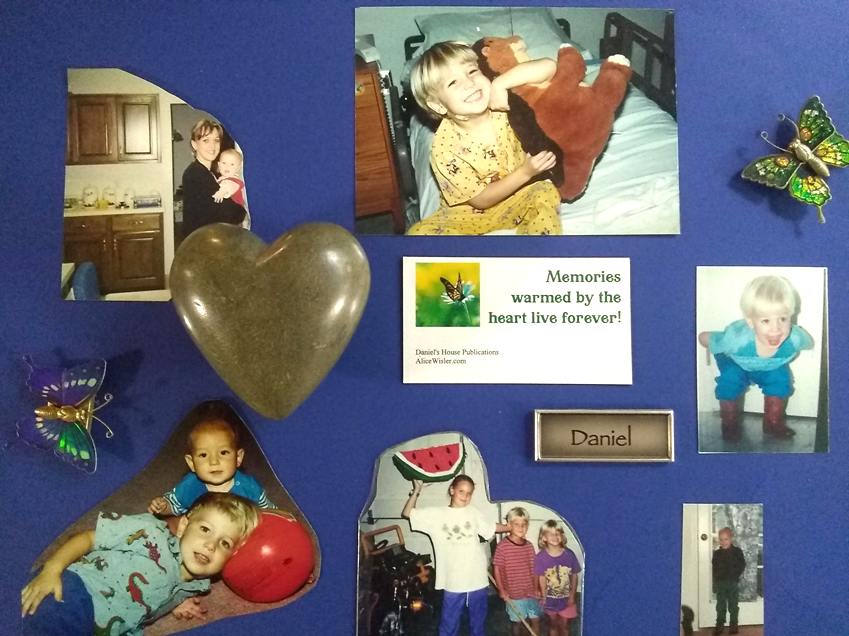
Years later—eighteen to be exact—I was seated in my grandma Stubbs’ mauve recliner, one I had inherited after her death. I looked through old photographs, color prints that mark time. It was a parade of matte and glossy visits—Easters with baskets bigger than my children, the Christmas we got the puppy, birthday cakes decorated with thick butter cream icing, our first night in the new house on Monticello—all made their appearances, chronicling the passage of the years. Rachel, Ben and Liz had all walked in and out and back in the new house many times again and again, even the puppy that grew into a senile beagle, made her way through and out the doggie door. But there would be one person who would never walk through the laundry room door inside or out. No one would ever see his smile or hear his laughter. He was gone, and yet he was everywhere. He was in every story we remembered and told.
The afternoon in my living room of remembering gave into the evening. Through the winter stillness, a train whistle sang—low, mellow, permeating the air. I didn’t stand, but my whole being was attentive until the song turned into only a murmur, as I envisioned its journey down the familiar tracks, tracks I could not see, but knew too well.
“Where is it going?”
Oh, Daniel, you know.
“The train’s going to Raleigh.”
And back again. And even beyond. There is so much to be discovered.
The story was already there, I just had to find the best way to make it come to life.
Showing posts with label Japan. Show all posts
Tuesday, July 13, 2021
Wednesday, November 30, 2016
An Author's Return to Japan After 28 Years
After being invited to my alma mater in Kobe, Japan, I was asked to write a piece for the Canadian Academy Review. Here it is in the Fall Issue.
An Author’s Return
Observing the Sunday morning activity at Hankyu Umeda
station brought back those memories that come with so much nostalgia—the kind
that almost forces you to abandon your plans, sit on the platform, and write. That’s what writers do, making non-writers
convinced that we’re a peculiar bunch; we carry notebooks and pens with the
spontaneity of capturing life onto the page. I wanted to write about what was
new since the last time I was in Japan.
My list consisted of cell phones, the Internet, Starbucks, Family Marts,
100 Yen stores, Yodobashi Camera stores, fashion, high-tech toilets, and my
alma mater—Canadian Academy.
When the train sailed into the station right on schedule, I
waited my turn and then gravitated toward a seat by the window just as I had
done as child. The other passengers were absorbed with their cell phones.
Unlike the old days, no one opened a magazine or paperback.
I reached in my purse for my journal and pen as a young girl
with a Hello Kitty bag sat across from me.
Some things haven’t changed, I thought, and made a list of what had
not: Hello Kitty’s hair bow, vending
machines that sell everything from cigarettes to energy drinks, student
uniforms, the speed of the Shinkansen, the taste of hot takoyaki on a winter evening, and the politeness of train station
personnel.
Twenty-eight years was a long time to be away from the
country of my birth. I felt like Urashima
Taro, the man in the folk story who goes back home to his fishing village after
being gone for three hundred years. I was both disoriented and delighted. I
also felt a bit like a dork when I had to pull out my reading glasses. The last
time I was in Kansai, I’d come back to visit my missionary parents and ended up
taking a job as an ESL teacher. Back
then I was able to study train schedules without reading glasses. Now I clung to them and just to be safe, asked
conductors if I was getting on the correct train, especially when I had to take
the JR Line, which I was unfamiliar with.
There was no time to spend being lost; I had only eight days
in Japan as Canadian Academy’s Alumna in Residence.
When I was a C.A. high school student, back in the 70s—about
the time that dinosaurs roamed—we had a rickety school building where the
floors and stairs creaked and the classrooms had radiators that hissed. Now the
new school on Ryokko Island is state-of-the-art with a theater, two gymnasiums,
an auditorium, and an atrium where flags hang from all the represented
countries. I was back at my alma mater and
yet, I was in a space so new to me that I was at the mercy of ninth graders to
get me to my assigned classes.
However, the curiosity of students had not changed. After I gave a tip on writing for a specific amount of time each day and the value of setting an egg timer, I was asked, “What’s an egg timer?” The students’ faces showed confusion until their English teacher explained the history of the wind-up device for keeping time, especially in the kitchen.
“How do you not get lazy?”
An excellent question!
Unfortunately, there wasn’t time to share all the tricks of the trade,
so I made my reply succinct. “There’s only way to stay disciplined,” I said.
“You have to plant your bottom on the chair in front of the computer. That’s
the way writing gets done.”
A boy in the back raised his hand. “Can you speak Japanese?”
“After twenty-eight years of not using it on a daily basis,
it’s rusty, but I can.”
I couldn’t help but reminisce about some of the missionaries
from my youth who came from states like Tennessee, Kentucky, and Alabama and spoke
Japanese in Southern accents. A request
was made. “Can you speak Japanese with a
Southern accent for us?”
The thrill of the task was so great, and yes, I could have
continued to talk in that syrupy twang for twenty minutes. But that was not
what I’d been invited to C.A. for. Quickly,
I put on my glasses, looked over my notes, and finished the lesson with
instruction on editing your writing. “You could be the world’s best story
teller, but if your grammar, spelling, and sentence structure are flawed, then
who is going to read your work?”
Except for Bob Hengal, who is still known after all these
years for his terrific baking, all of the teachers were new. I wondered if a few were actually high school
students; they looked much too young to be teaching. One said that I had his
permission to include him as a character in my next novel.
“You can kill me off,” he whispered while his class engaged
in a writing exercise that started with the line, I knew why the coastal town was haunted. “Really.” He smiled. “I won’t mind if you do.”
On the weekend, I was grateful for two fellow class of 1979
graduates who met me in Kyoto for a mini-reunion. After all, I needed to touch base with those
who remembered the way things used to be.
Of course, Hanae Hosoda and Ioanna Sillavan recalled the long and
tiresome walks up to C.A. when it was on the hill with the picturesque view of
Kobe Harbor. They agreed that the school had felt old and creaky, but that it
had been the familiar kind of old, like a worn pair of favorite tennis
shoes. Over a lunch of sukiyaki, and
later, at a kissaten, we talked and
laughed, weaving in the past with our current lives, our kids, work, and
spouses. No one would have guessed that
it had been thirty-seven years since the three of us had last seen each other.
My days back in Japan were a gift. In the legend, Urashima Taro was given a
lacquer box by the beautiful princess from the enchanted paradise under the sea. Although she told him not to open it upon
returning home, it was too late. The desire to peek inside turned Taro from his
preserved youth into an old man with a gray beard.
While I might have felt like an old graduate, there was a vitality
that sprung while I was at C.A. In spite of jet-lag and culture shock, I felt
renewed and rejuvenated. I was so
inspired that my current work-in-progress is about the return to my home land,
the place where my love of writing began so many years ago.
And no, I do not plan to kill anyone off.
~ Alice J. (Stubbs) Wisler, Class of 1979
Author, Blogger, Bread Maker, Business Owner
Durham, North Carolina
Labels:
a writer's life,
Alice J. Wisler. Alice Wisler,
Canadian Academy,
Canadian Academy Alumni Review,
Japan,
Kobe,
writers
Wednesday, October 5, 2016
Some Thoughts on Home
Home, for me, is always going to be divided. I was born and raised in Japan, with periodic visits to the USA (where my citizenship lies). As a young adult, I spent time in other parts of Asia and at age 24, returned to Japan to teach English in a church-run language school. Osaka is where I met my first husband. My four children were all born in Durham, North Carolina where I've been able to put down roots over the last 28 years.
Recently, I was invited by my high school to go back to Japan and be their alumna author in residence. Wow, for the first time I experienced culture shock in Japan! After 28 years of being away, things sure had changed and I'd changed, too. And yet, on the other hand, so much was familiar. The coziness of having hot tea and a green tea Swiss roll at a kissaten (coffee shop), the crowds and pace of Umeda, the "calm feel" of the majestic city of Kyoto, the mountains of Kobe in the distance, and the kindness of strangers when I had trouble purchasing my ticket from a very modern ticket dispenser.
For the first time I didn't experience any culture shock when I landed back in the USA after the trip was over. Being back in Japan made me miss it all over again and I wondered (before I left) how I would resume my life in the USA . . . But my children, husband, and friends helped me to ease back to life here.
Home is such a strange word for me. I will always feel that I have two homes. When I landed in Osaka this past January, the alumni director of my high school said, "Welcome home."
When I landed in Newark, New Jersey, ten days later, my new husband texted me: Welcome back to the USA. Welcome home.
Tuesday, February 16, 2016
"If I hate, I should hate war itself."
![]() |
| Hiroshima (Taken during the 9th grade field trip, January 29, 2016.) |
Tiny, humorous, endearing, Koko Tanimoto Kondo told her story inside the Canadian Academy auditorium to ninth grade students. She was just eight months old the day her world exploded. Literally. The Enola Gay did what it was sent to do over her hometown of Hiroshima. At just 1.2 kilometers away from the epicenter, the Tanimoto house crashed around Koko and her mother. When Mrs. Tanimoto regained consciousness, she heard a baby cry.
That baby belonged to her. She had to do something quick.
Koko was too little to know what was happening to her city at that moment, but over the years, she heard the story and now tells it to audiences across Japan and the USA. "My mother made a hole (in the debris) and was able to make it out," she said. "Our house was on fire." Her father was working at his church that morning, but desperate to find his family.
Koko grew up angry. She wanted to "get back" at the people who had destroyed her city. She wanted to punch and kick those who had marred the faces of the older girls who came to her father's church after the attack. Their faces----distorted from the burns of the bomb's blast. Their bodies, disfigured and permanently scarred.
Authors always have their characters and novels close by in their hearts. More than anything, we want to be authentic in our portrayal of both history and human emotions. As I listened to Koko talk, I briefly made a mental note: It's in line. What I meant was how I portrayed my characters following the attack. In my World War II novel, Under the Silk Hibiscus, I let my characters (Japanese-Americans living in Heart Mountain, a Wyoming internment camp) be devastated by what the USA had done to their country of origin. Papa Mori had family in Hiroshima----his home town before coming to California to raise his own family----and getting letters about relatives dying from radiation tore him up inside. He was only a shadow of the man he once was when the war finally ended.
Koko's words brought another scene from my novel to mind as she continued her talk.
When she was in fifth grade, she and her family (after their story had been documented in John Hersey's Hiroshima) were invited to be on the American show, This is Your Life. Koko recalled that day and lifting a fist into the air, told us that at that time she was ready to punch and kick the co-pilot of the Enola Gay, also a guest on the show. She wanted revenge. When the host of the show asked Captain Robert Lewis how he felt after dropping the bomb on Hiroshima, the co-pilot said, "Hiroshima disappeared. And I said, 'My God, what have we done?'"
Instantly, Koko saw the "bad evil" in herself. "If I hate, I should hate war itself. Not this person," she recalled. Slowly, like a crab, she walked over to Captain Robert Lewis. She just wanted to touch his hand. When she got close to him and reached out her hand, he took it and squeezed.
Forgiveness.
Nathan, my main character, forgives an American soldier from Heart Mountain, the camp where Nathan was interned. Was the forgiveness realistic? As I listened to Koko's rationale for forgiveness, I knew that forgiveness for a act so grievous could be granted. For like Koko, my fictitious Nathan realized that he was just as wretched in his own heart as the soldier was. He desired to be forgiven and, in turn, knew that he wanted to forgive his enemy. God's grace.
![]() |
| Under the Silk Hibiscus at Canadian Academy in Kobe, Japan |
Again, I made a note: It's in line. Check!
Koko, now 71-years-old, promotes peace. "It's up to you," she said to the students in the auditorium, as she encouraged them to become peace keepers. "Will you help me to spread peace in this world? I want you to be the ones to change the world."
After her talk, I was invited to eat lunch with her and Bob Hengal, a teacher at Canadian Academy who was instrumental in bringing me from my home in North Carolina to the school as an alumna author. Koko's lively comments over each course that was served showed appreciation for the culinary experience. Before we parted at the train station, we had photos taken together.
It was an unexpected day of inspiration coupled with a wealth of history for this missionary kid born and raised in Osaka. It was one of those experiences that are so monumental that you feel you don't deserve, but you are graciously given.
And gratitude dances in your heart.
![]() |
| Koko Kondo and me, daughters of ministers Kobe, Japan |
Under the Silk Hibiscus on Amazon.
Labels:
a writer's life,
Alice J. Wisler,
Atomic bomb,
Captain Robert Lewis,
Hiroshima,
Japan,
Kobe,
Koko Tanimoto Kondo,
Lighthouse Publishing of the Carolinas,
missionaries,
Under the Silk Hibiscus,
World War II
Monday, June 1, 2015
Childhood Days: On Being a Foreigner
I wrote the following over two years ago for a blog called Boomer Bits and Bytes. I dug it up and decided to re-post today. Tell me your thoughts.
~* ~*
It’s never a good day when you feel those jolts of fear moving up and down your spine like someone’s wired you to an electric circuit. But as she studied my face, I felt them, and I knew without a doubt that I’d done something wrong.
It was Mother’s Day 1967, and the neighborhood kindergarten I attended invited moms to the school for a celebratory program. Each mother received a red carnation to pin to her clothing and then was ushered into classrooms to view some of the best artwork this side of Tokyo. Wearing a floral dress, her carnation, and a hint of perfume, my mother entered my classroom, ready to find the portrait I’d drawn of her.
Removing her sunglasses, she glanced around the walls. She stepped closer in, scanning the heavy oil-based pastel-colored creations. Then with an emphatic sigh, she looked at me. “Alice, where is your picture?”
My picture! We were right in front of it. Could she not see? Although worry clouded my mind, even so, I held it together. Don’t make a scene, never draw attention. Gingerly, I moved toward the wall. Standing on tiptoes, I pointed to the motherly face I had created.
Mom looked at the oval shape that held black eyes, red lips, and locks of black hair.
I had colored a little out of the lines, so there was some pink crayon—the color I’d used for her necklace—rubbed into her collar, but overall, the portrait was one I was pleased with. I smiled at Mom, expecting her to smile back.
There was no smile. “Alice,” she cried, “I don’t have black eyes or black hair.”
With feet now planted on the classroom floor, I avoided her expression. Seeing her every day, I knew what she looked like. But did she think that I was going to use a brown crayon or blue one to draw her hair and eyes when the other children were sharing the popular black crayon? So, I gave her a pair of eyes and hair to match my classmates’ artwork.
Knowing I was a foreigner was as familiar to me as the frequented candy store. Even so, I wanted to blend in. I tried to be inconspicuous, never stand out, or be different, noticed, pointed at, and ridiculed. However, with blond hair, brown eyes, and a light complexion, and even tall by American standards, I was clearly unique in a country where black hair, olive complexions, dark eyes and short statures were dominant.
I was born in Osaka, on a frosty January night in a hospital across from a Hankyu train track. I don’t know if I was born on the right or wrong side of those tracks, but I do know that I had a perfectly shaped round head and was as bald as a snow man. My head was unscathed because I didn’t use it to push through the birth canal. Later, I would realize that I was born lazy and would have to fight that tendency especially when it came time to do my chores or complete algebra homework.
Naturally, my parents gave me a name at birth but the locals called me something else. Gaijin. They called my friends with blond hair the same thing and even that pesky kid who tried to look up my skirt in third grade. (He was cute and gave me a Valentine, but he was still nasty.) My father, mother, and baby brother were also called gaijin.
The Chinese characters for the word gaijin are soto jin, meaning outsider. In Japan this takes care of anyone who is not a native of the nation of Japan, which comes to just about ninety-six percent of the world.
When a small child would see me and lift his finger to point, I wanted to disappear. My mom would sometimes point her finger back at the kids and call them gaijin which only embarrassed me more and made the kids laugh and scream all the louder. Didn’t she know we were to be seen but not heard? Never cause a ripple; be the good American. Besides, they didn’t realize that what she was doing was more than mimicking them; she was calling them foreigners. They didn’t understand that to outsiders like us, even they were soto jin.
One afternoon, young Japanese boys that often slid over the concrete wall from the nearby apartment complex, came to the hospital compound to play. Standing in a grassy field of clover, they saw my little brother by a large oak tree. Picking up stones, one yelled, “Gaijin!” Quickly, in chorus, the other boys followed suit. Stones flew past Vincie, some landed at his feet, while others bounced off the tree trunk. Vincie made his way to our front gate, entered it, and escaped into our home. To his advantage, the kids didn’t have the best aim, and physically, he was unharmed.
Occasionally, the sisters of these boys came over to find me, calling out, “Arisu-chan, asobo!” (“Alice, let’s play.”) Unlike their brothers, they were kind and sat with me in the clover field behind the hospital, weaving crowns and necklaces out of clover for me to wear. Seated beside them in the mass of green, I wanted to play dolls and house as I did with my missionary neighbor Jo Jo. I was weary of being asked the same questions, talked about as if I couldn’t understand, and being stared at.
~*~*
At the time I had no clear concept of the United States, my country of passport, but one day, I would be reminded of how different it was from this crowded island. In my teen years, I would long for things about it, yet not understand most of its ways, and wonder how I fit in.
Little did I know, but I would have a lifetime of figuring out how to fit in.
~* ~*
It’s never a good day when you feel those jolts of fear moving up and down your spine like someone’s wired you to an electric circuit. But as she studied my face, I felt them, and I knew without a doubt that I’d done something wrong.
It was Mother’s Day 1967, and the neighborhood kindergarten I attended invited moms to the school for a celebratory program. Each mother received a red carnation to pin to her clothing and then was ushered into classrooms to view some of the best artwork this side of Tokyo. Wearing a floral dress, her carnation, and a hint of perfume, my mother entered my classroom, ready to find the portrait I’d drawn of her.
Removing her sunglasses, she glanced around the walls. She stepped closer in, scanning the heavy oil-based pastel-colored creations. Then with an emphatic sigh, she looked at me. “Alice, where is your picture?”
My picture! We were right in front of it. Could she not see? Although worry clouded my mind, even so, I held it together. Don’t make a scene, never draw attention. Gingerly, I moved toward the wall. Standing on tiptoes, I pointed to the motherly face I had created.
Mom looked at the oval shape that held black eyes, red lips, and locks of black hair.
I had colored a little out of the lines, so there was some pink crayon—the color I’d used for her necklace—rubbed into her collar, but overall, the portrait was one I was pleased with. I smiled at Mom, expecting her to smile back.
There was no smile. “Alice,” she cried, “I don’t have black eyes or black hair.”
With feet now planted on the classroom floor, I avoided her expression. Seeing her every day, I knew what she looked like. But did she think that I was going to use a brown crayon or blue one to draw her hair and eyes when the other children were sharing the popular black crayon? So, I gave her a pair of eyes and hair to match my classmates’ artwork.
Knowing I was a foreigner was as familiar to me as the frequented candy store. Even so, I wanted to blend in. I tried to be inconspicuous, never stand out, or be different, noticed, pointed at, and ridiculed. However, with blond hair, brown eyes, and a light complexion, and even tall by American standards, I was clearly unique in a country where black hair, olive complexions, dark eyes and short statures were dominant.
I was born in Osaka, on a frosty January night in a hospital across from a Hankyu train track. I don’t know if I was born on the right or wrong side of those tracks, but I do know that I had a perfectly shaped round head and was as bald as a snow man. My head was unscathed because I didn’t use it to push through the birth canal. Later, I would realize that I was born lazy and would have to fight that tendency especially when it came time to do my chores or complete algebra homework.
Naturally, my parents gave me a name at birth but the locals called me something else. Gaijin. They called my friends with blond hair the same thing and even that pesky kid who tried to look up my skirt in third grade. (He was cute and gave me a Valentine, but he was still nasty.) My father, mother, and baby brother were also called gaijin.
The Chinese characters for the word gaijin are soto jin, meaning outsider. In Japan this takes care of anyone who is not a native of the nation of Japan, which comes to just about ninety-six percent of the world.
When a small child would see me and lift his finger to point, I wanted to disappear. My mom would sometimes point her finger back at the kids and call them gaijin which only embarrassed me more and made the kids laugh and scream all the louder. Didn’t she know we were to be seen but not heard? Never cause a ripple; be the good American. Besides, they didn’t realize that what she was doing was more than mimicking them; she was calling them foreigners. They didn’t understand that to outsiders like us, even they were soto jin.
One afternoon, young Japanese boys that often slid over the concrete wall from the nearby apartment complex, came to the hospital compound to play. Standing in a grassy field of clover, they saw my little brother by a large oak tree. Picking up stones, one yelled, “Gaijin!” Quickly, in chorus, the other boys followed suit. Stones flew past Vincie, some landed at his feet, while others bounced off the tree trunk. Vincie made his way to our front gate, entered it, and escaped into our home. To his advantage, the kids didn’t have the best aim, and physically, he was unharmed.
Occasionally, the sisters of these boys came over to find me, calling out, “Arisu-chan, asobo!” (“Alice, let’s play.”) Unlike their brothers, they were kind and sat with me in the clover field behind the hospital, weaving crowns and necklaces out of clover for me to wear. Seated beside them in the mass of green, I wanted to play dolls and house as I did with my missionary neighbor Jo Jo. I was weary of being asked the same questions, talked about as if I couldn’t understand, and being stared at.
~*~*
At the time I had no clear concept of the United States, my country of passport, but one day, I would be reminded of how different it was from this crowded island. In my teen years, I would long for things about it, yet not understand most of its ways, and wonder how I fit in.
Little did I know, but I would have a lifetime of figuring out how to fit in.
Labels:
Alice J. Wisler,
American kids,
childhood,
foreigner,
gaijin,
Japan
Friday, April 24, 2015
See why this novel is invited to Japan!
I grew up in classrooms filled with kids and teachers from all over the world. My high school, Canadian Academy, located in Kobe on top of a hill, had a view of the harbor which looked beautiful. My school also had a grassy area where we ate lunch in the warmer months. I recall looking around at my senior friends and noting the countries they represented. Malfrid from Norway, Sophie from France, Jules from Canada (the French region of Quebec), Sangeeta from India and Japan, Nada from Lebanon, Katie from California, USA. We are like a United Nations, I thought.
I know I almost failed algebra. And hated biology. But I never recalled learning anything in history about internment camps for Japanese-Americans during War World II.
I wish I had listened. One of my classmates' mom was in a camp during her youth. But that didn't register in my mind until long after I held my high school diploma.
It would be years later when I felt the need to write about this period of history. It would be when living in another country, at another setting. In North Carolina, I heard my friend Artie Kamiya talk about his mother who had been forced to spend years in a camp in Colorado after President Roosevelt issued Executive Order 9066. Shortly after Pearl Harbor was bombed, those of Japanese descent on the West Coast of the U.S. were sent to various camps. Many forced to these camps were American citizens. Most had never even been to Japan.
This shows just has strong fear and prejudice go and how they eat at people's hearts and minds. Americans, born in the United States, had to leave their homes, board trains with one suitcase each, and head to bleak camps where barracks became dwelling places.
I wrote Under the Silk Hibiscus with the help of materials I received from Artie's mom. I was also able to interview Terri Takiguchi, a woman in my church who was sent from her life in California to a camp in Arizona during the war.
And this time I listened. At my computer, I heard the voices of dozens of others as I watched videos about one camp in particular---Heart Mountain in Wyoming. This camp became the setting for my fictional family, Nathan Mori, his siblings, mother, and aunt.
When I got the news that my high school wants me to come to Japan as an alumni author in residence, I couldn't believe it! Even now, most days, I think that I'm still dreaming. It's been since 1988 when I was there last as a teacher of English.
Early next year, I'll be flying to Japan, the country of my birth and childhood. In addition to going on a field trip with ninth graders to Hiroshima, I'll share about being an author and how I researched for my novel. I hear authentic food calling my name, too: Unagi, katsudon, chirashizushi, oyakodomburi, an pan, and of course, green tea ice cream (as pictured below).
I know it will be a most wonderful reunion.
You can read more about Under the Silk Hibiscus here.
Labels:
Alice J. Wisler,
Hiroshima,
Historical fiction,
inspirational fiction,
Interment camps,
Japan,
Japanese-Americans,
Kobe,
Lighthouse Publishing of the Carolinas,
Under the Silk Hibiscus,
World War II
Friday, July 13, 2012
Childhood on the Train
This was first posted at Geezer Guys and Gals, but I also wanted to include it here for my readers.
Enjoy!
~*~*~*
We know that any "seasoned" woman or man from an older generation is accused of telling anecdotes of how as a child she/he used to have to walk to school uphill in the snow. For at least ten miles. Without a warm coat. I didn't have to walk in the snow to school, but I did have to ride the train. That was forty-seven minutes to school and forty-seven minutes back. "So," I tell my kids, "Your mother had it rough." But looking back, I wouldn't trade those experiences for anything.
We were six years old when we started riding the Hankyu line to school in the sixties from Awaji to Karasuma. During the winter mornings, the windows steamed up and we wrote our names on them. In the late afternoons, we crocheted long red scarves, tried to make sense out of math homework, and avoided conversing in English with Japanese men with brief cases.
You had to know a thing or two in order to be a proficient train rider, and the younger children learned the ropes from the older kids.
Rule number one was to walk briskly out our gates from our missionary homes. Once the five of us blond-haired American kids gathered, we marched past the incinerator behind the Yodogawa Christian Hospital, out the hospital gates, to the left, toward the station. Sometimes at 7 AM there was a dusting of frost on the grass. Sometimes one of us lagged behind due to racing back for forgotten homework or a lunch box. We had to pick up the pace; we had a train to catch and it would, sure as tofu is made from bean curd, not be late---even if we were.
Once the train pulled into the station, doors slid opened and passengers boarded the already packed car. Gloved station attendants pushed commuters onto the cars as the whistle blew. Inside the car, we lifted book bags onto the luggage racks or held them between our feet. Then we grabbed the hand rails—loops of plastic suspended overhead—as the train picked up the pace toward Kyoto.
The next rule was to be extremely quiet as the train doors opened at Takatsuki-shi. I think we heard David O talking to himself even before he boarded the car. We held our breath and closed our eyes, as though those actions would keep him from spotting us. As silent as we were, he always managed to find us.
"Hey," he said one morning so that passengers five cars down could hear. "I got this new chemistry set. Wanna see it?" He hoisted a brown square bag.
No one responded.
David O nudged me, his elbow poking both me and a woman trying to read a paperback. "It's really cool."
I was shy, especially around a boy who was two years older than I. While the other kids engaged in conversation leaving me alone to talk to David O, I shook my head and clung to the handrail.
At last, sensing he was being ignored, and the train was too congested to show us vials and test tubes anyway, he offered to show it to us later.
The third rule came into play at our destination. Immediately, when the doors opened, we were to head up the platform stairs as fast as we could. We raced past ladies in gray kimono and weaved between businessmen so that we could be first in line at the taxi stand.
Our final part of our journey was to ride a cab (five of us missionary kids packed into one Nissan) for six miles to our tiny international school where spelling tests and math equations greeted us. At recess, we enjoyed games of Kick the Can and Red Rover, Red Rover.
I have fond memories of those long treks to school. I smile to think how unusual we must have seemed in a land where the natives all had black hair and dark eyes, were dignified and soft-spoken. We were blond, tall, loud and rowdy.
And as for David O and his chemistry set, I did get to see it. One afternoon on a rather empty train car, he spread his set of chemicals and glass beakers onto the seat. As the train rounded a field of rice paddies, the whole car jerked, and my friend Josephine and I watched the green seat turn red and yellow. The conductor raced out of his compartment in a fury, yelling at the Canadian boy for damaging the train seat. David O hung his head while the conductor covered the stained seat with mounds of newspaper.
Which brings me to the next rule for riding the trains---this one became extremely important for survival. When the train conductor fumed over a spilled chemistry set, it was best to run---not walk---away as fast as possible.
And as Josephine and I crouched inside another car, we closed our eyes and were silent, hoping that perhaps no one would notice that we had anything to do with the boy who had caused a scene.
~ Alice J. Wisler grew up in Japan where she rode the train to and from school and dreamed of being an author. Now she lives and writes in Durham, NC and looks forward to the release of her fifth novel, Still Life in Shadows from River North. Her other novels are: Rain Song, How Sweet It Is, Hatteras Girl and A Wedding Invitation (all published with Bethany House). She also teaches writing workshops, both online and at conferences. Visit her website.
Enjoy!
~*~*~*
We know that any "seasoned" woman or man from an older generation is accused of telling anecdotes of how as a child she/he used to have to walk to school uphill in the snow. For at least ten miles. Without a warm coat. I didn't have to walk in the snow to school, but I did have to ride the train. That was forty-seven minutes to school and forty-seven minutes back. "So," I tell my kids, "Your mother had it rough." But looking back, I wouldn't trade those experiences for anything.
We were six years old when we started riding the Hankyu line to school in the sixties from Awaji to Karasuma. During the winter mornings, the windows steamed up and we wrote our names on them. In the late afternoons, we crocheted long red scarves, tried to make sense out of math homework, and avoided conversing in English with Japanese men with brief cases.
You had to know a thing or two in order to be a proficient train rider, and the younger children learned the ropes from the older kids.
Rule number one was to walk briskly out our gates from our missionary homes. Once the five of us blond-haired American kids gathered, we marched past the incinerator behind the Yodogawa Christian Hospital, out the hospital gates, to the left, toward the station. Sometimes at 7 AM there was a dusting of frost on the grass. Sometimes one of us lagged behind due to racing back for forgotten homework or a lunch box. We had to pick up the pace; we had a train to catch and it would, sure as tofu is made from bean curd, not be late---even if we were.
Once the train pulled into the station, doors slid opened and passengers boarded the already packed car. Gloved station attendants pushed commuters onto the cars as the whistle blew. Inside the car, we lifted book bags onto the luggage racks or held them between our feet. Then we grabbed the hand rails—loops of plastic suspended overhead—as the train picked up the pace toward Kyoto.
The next rule was to be extremely quiet as the train doors opened at Takatsuki-shi. I think we heard David O talking to himself even before he boarded the car. We held our breath and closed our eyes, as though those actions would keep him from spotting us. As silent as we were, he always managed to find us.
"Hey," he said one morning so that passengers five cars down could hear. "I got this new chemistry set. Wanna see it?" He hoisted a brown square bag.
No one responded.
David O nudged me, his elbow poking both me and a woman trying to read a paperback. "It's really cool."
I was shy, especially around a boy who was two years older than I. While the other kids engaged in conversation leaving me alone to talk to David O, I shook my head and clung to the handrail.
At last, sensing he was being ignored, and the train was too congested to show us vials and test tubes anyway, he offered to show it to us later.
The third rule came into play at our destination. Immediately, when the doors opened, we were to head up the platform stairs as fast as we could. We raced past ladies in gray kimono and weaved between businessmen so that we could be first in line at the taxi stand.
Our final part of our journey was to ride a cab (five of us missionary kids packed into one Nissan) for six miles to our tiny international school where spelling tests and math equations greeted us. At recess, we enjoyed games of Kick the Can and Red Rover, Red Rover.
I have fond memories of those long treks to school. I smile to think how unusual we must have seemed in a land where the natives all had black hair and dark eyes, were dignified and soft-spoken. We were blond, tall, loud and rowdy.
And as for David O and his chemistry set, I did get to see it. One afternoon on a rather empty train car, he spread his set of chemicals and glass beakers onto the seat. As the train rounded a field of rice paddies, the whole car jerked, and my friend Josephine and I watched the green seat turn red and yellow. The conductor raced out of his compartment in a fury, yelling at the Canadian boy for damaging the train seat. David O hung his head while the conductor covered the stained seat with mounds of newspaper.
Which brings me to the next rule for riding the trains---this one became extremely important for survival. When the train conductor fumed over a spilled chemistry set, it was best to run---not walk---away as fast as possible.
And as Josephine and I crouched inside another car, we closed our eyes and were silent, hoping that perhaps no one would notice that we had anything to do with the boy who had caused a scene.
~ Alice J. Wisler grew up in Japan where she rode the train to and from school and dreamed of being an author. Now she lives and writes in Durham, NC and looks forward to the release of her fifth novel, Still Life in Shadows from River North. Her other novels are: Rain Song, How Sweet It Is, Hatteras Girl and A Wedding Invitation (all published with Bethany House). She also teaches writing workshops, both online and at conferences. Visit her website.
Labels:
Alice J. Wisler,
childhood on the train,
Japan,
memoir
Subscribe to:
Posts (Atom)


