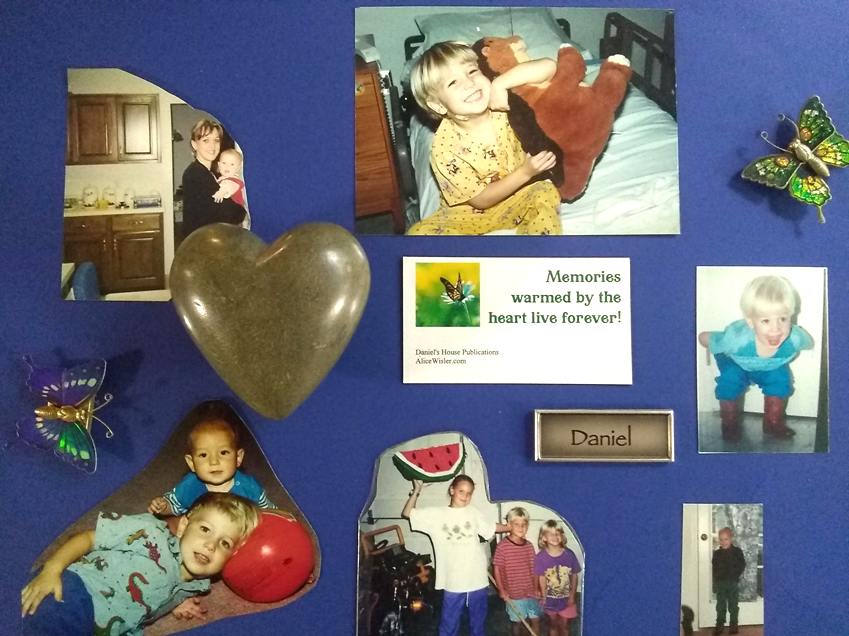
Showing posts with label Daniel Paul Wisler. Show all posts

Monday, June 26, 2023

A Little Book that Took a Long While


It's here, it's here, it's here!

My memoir, Life at Daniel's Place, is now in both paperback and e-book! If you've been following my blog posts and newsletters, you will understand the enormity of what has finally transpired. My memoir has had so many starts, stops, epiphanies, and overhauls. Whew!

Can a graveyard ever offer tranquility after turmoil? At first, Alice wants to run from the cemetery because it symbolizes that Daniel, her four-year-old son, is gone. Being at the grave fills her with shame, guilt, and doubt. Gradually, thanks to geese, picnics, helium balloons, and epitaphs, the cemetery, named Daniel’s Place by Alice’s family, becomes a haven of discovery and beauty. Life at Daniel’s Place is the story of a mother’s heart transformed from fear to certainty and confidence. Alice’s reflections remind us that even in trauma, a renewed faith in God is possible and welcomed.

I am so glad that my memoir is now in print and ready for you to read!

I hope you'll get your copy of Life at Daniel's Place: How the cemetery became a sanctuary of discovery and gratitude. You can order from Amazon now.

Saturday, January 22, 2022

Love: Does it End with Death?

I love Daniel.

Daniel’s been gone from Earth for almost 25 years (February 2 is the day he died). Over the years I’ve discovered a multitude of things about grief, about my grieving self— guilt, longing, the lonely hour of 3 AM—and about the way society handles loss.

After a loved one dies, we tend to use the past tense. Instead of I love Daniel, the acceptable thing to say is I loved Daniel. Since Daniel is not living any more, society speaks of him in the past tense. All of the characteristics of him are spoken in past tense, too. Daniel liked to collect stickers; Daniel’s favorite movie was Toy Story, the very first one. He recited jokes from a weathered joke book. He fought bedtime. He had a mischievous smile, especially on the day he went into my desk drawer, took out a self-inking Thank You stamp, and stamped his legs with it.

I know Daniel died. I was there when it happened. I’m not delusional about things, except for when it comes to algebra because that has never made sense to me. I believe that when Daniel took his last earthly breath, his soul arrived in Heaven. He is now in the presence of Jesus, his Savior, whom he learned about in church and through Bible stories from an illustrated book. Daniel still exists; he’s just doesn’t exist here on Earth anymore, except for in our memories.

I loved him while he was my son, for those four short years that I was privileged to be his mama. I still love him, as I love my three adult children who live close by. My love for Daniel has not stopped just because he isn’t with us and I can’t see him open a birthday gift or eat the grilled cheese sandwiches he was fond of enjoying or get his photo taken by the Christmas tree.

I love Daniel. I’ll say it again. I love Daniel. And I invite you to use the present tense when you are talking about the love you hold for your loved one that has passed onto the heavenly eternal.

Even death cannot end the love we have. We don't stop loving a person just because he or she is gone. Love goes on.

Thursday, August 26, 2021

Lessons from a Balloon-sending Mama

On your 29th birthday, I make my pilgrimage to the grave. Carl parks the Jeep and at your marker, I wipe away the brittle patch of cut dried grass. There's a strip of blue painter's tape stuck to the side. It's in Rachel's handwriting. We love you, Daniel. You've inspired so many people. I take a photo of your oldest sister's note and smile, sending a text to her so that she can see my appreciation.
I put a bunch of red Dollar Store Gerber daisies in the dirt by your marker. They aren't my favorite color Gerbers, but they were the best looking plastic flowers the store had. I take another photo of your grave and wish I could take a photo of you instead. I probably have the largest collection of grave marker photos that any mother has ever accumulated. They span my life over the last twenty-four years since you left us.

I walk over to Solomon's grave. When I found his marker years ago, I shed tears. From II Timothy 4:7 the words are enscribed: I have finished my course. I have kept the faith. If the day wasn't so hot, I would amble over the grass to visit Taylor's grave because his is one that also has touched my heart. We're so glad you came. Beside your grave is Audrey, who has only the year enscribed on her marker. And a large heart. I assume she, like Taylor, died the day she was born.

Under the shade of a tree, I sit on your Thomas the Tank Engine towel and pour into a cup orange-grapefruit seltzer water. The liquid is welcomed. I had planned to stay a longer time seated on the towel, coming up with something profound to write. But the afternoon is hot and humid. The dashboard of the Jeep, says it's 97 degrees F. Carl sits in the Jeep because it's cooler there.


I come to the cemetery with rituals that I have gathered over the years since you've been gone. One is to walk the premise. I have a pair of new tennis shoes on this afternoon. What better place and day to break them in. Briskly I make the round, and am grateful for a breeze. I remember when this location made me feel shame for not having been able to keep you alive. I never expected to have grown from my visits here. I never knew solace at my son's grave was possible. The years have been hard; the journey filled with sadness, but the lessons I have acquired are nothing short of priceless.

After my lap, I write a note to you on a slip of paper. It is my usual note about loving and missing you. On the back of it, Carl writes some words. I peek to see he has written. His words are: Too bad I never got to meet you. He has drawn a heart and signed his name. The love he shows for me by coming with me on this cemetery pilgrimage shouldn't be overlooked.

Inside the Jeep, together we string the note (I've punched a hole in the sheet with a pen) to another Dollar Store purchase----a red star balloon filled with helium.

And then we walk to the center of the cemetery as I hold tightly to the string. "Happy birthday, Daniel," we both say. I release the string which allows for the balloon to jet away from me and climb into the sky. We stand watching the wind do its part as the baloon travels. Soon it's blocked by two large oaks. Carl steps to the left and I follow so that we have a better view. We watch, eyes shielded from the August sun, until the balloon becomes a dot and then vanishes from our sight into a distant cloud.

Twenty-four years of lifting balloons into the sky, my symbolism of releasing love, of watching something perform what I cannot---an item sail into the sky on its own, climbing closer to Heaven. Twenty-four years of an ache that will not leave. I love you, Daniel. My love for family and friends has grown over these long years, so it makes sense that the love for you has increased also. I love you today and I will love you more tomorrow.

And those are a few of the lessons that grief has taught me.

Tuesday, July 13, 2021

Make it Come to Life : Prologue to a memoir

A view from a train window can kick start a fascinating story. Look what it did for Walt Disney. On a journey from Manhattan to Hollywood in 1928, Walt looked out his window as large towns gave way to wheat and corn fields. And there, under an apple tree, Mickey Mouse showed up. Perhaps Mickey waved a white-gloved hand, or maybe he just smiled. Walt captured him on a sketch pad and the stories began. Walt’s gone now, but his cartoon mouse has traveled all over the world and lives forever.

Although I grew up on trains in Osaka, Japan, my creations weren’t the kinds you sketch, but printed words. I looked out the windows and instead of a mouse, four teens appeared on a boat. They needed an ocean to take them to a remote tropical island where they would get lost, build campfires at night, eat mangos the size of footballs, and have fascinating adventures with the natives. I put them in a rowboat (at age eleven I was not the smartest seafarer which meant neither were my characters) and let a storm fester with just enough wind for their vessel to wash against the shoreline of the island. I named the island Blue Hama (I suppose I didn’t have the knack for good names at age eleven either).

Later, when I had crushes on boys with names like Ethan and Harold, I looked out the window as trains took me to and from school, and saw handsome boys on bicycles near parks where they met pretty girls named Belinda, Camithia, and Sylviana. I bought spiral notebooks at the local stationer’s near my home in Awaji, knowing that each notebook would be the place where a best seller would be brought to life and I’d be rich and famous before I turned twenty.


Each train ride from Awaji to Karasuma—the station closest to my international school—took forty-seven minutes. That’s a lot of time to peer out of windows. In the afternoons, the train was less-crowded and when I got to sit down, I lured my characters, bringing them from outside where they began along the tracks, to inside the pages of my notebooks. I gave them words, obstacles to conquer, and lots of love in their hearts.

If Walt and I had ever crossed paths, or if we’d been seated on the same train, he might have used his pencil to draw me as a kid. Two blond ponytails sticking out from just below my ears, plaid skirt, red tights that bagged around my ankles by the time school got out, and a pair of black patent-leather shoes that were magnets for doggy poop. In my hand would be a yellow number 2 pencil sans an eraser on the end because erasers never last the lifetime of pencils. The pencil would be scratching out my messy words (I had what was known back then as sloppy penmanship) over the lined notebook’s pages, and my ears, although not as prominent as Mickey’s, would be stretched to listen for the conductor’s announcement of my train station.

I spent my childhood on trains. And when I wasn’t on one, I was running to catch one or if I missed it, waiting for the next one on the platform.

Every parent has some story they repeat and repeat, passing it onto their offspring. That’s how those tales of suffering get handed down like certain unwanted family heirlooms: “I had to walk to school in the snow.” “I had to walk up hill in the snow both ways.” “I had to walk in the snow both ways with no shoes.” Mine is: “I had to ride the train to school every day for forty-seven minutes. And that was just one way!” And like any other parent, I’m always subject to the indifferent attitudes my children display when my story is told.

When the Amtrak thundered over the track that day in 1996, I no longer rode the train to school. I was a grown woman of 35 with three of my own children. My middle child, Daniel, aged three, was by my side as we watched the silver cars streaked with red, white, and blue. One after another, after another, racing along, going somewhere. We stood, silent, as one does during the singing of the national anthem or during a prayer. The track was just beyond the slide and swings and the shade of the massive oak tree where we’d had a picnic lunch of peanut butter and jelly sandwiches because those are the easiest for moms to make.

The sound of a train has always tugged at the wild hope chord of my heart. A train symbolizes a way toward a happy destination, but more—the actual journey, looking out the window, passing places you’ve never set foot in, capturing vistas that are quaint, majestic, or even spiritual.

Daniel seemed to understand my need for reverence, he paused from playing with Caleb and tickling his baby brother Ben to be captivated with me.

But once the train was out of sight, he left me for the slide. He climbed up the ladder and at the fourth rung, stopped. “Where is the train going?” he asked.

“To the next station.”

But my reply didn’t seem enough for my son. “Where is the next station?”

I know that Moms are supposed to have all the answers, it comes in a kit they hand you at the hospital after delivery, soon after the umbilical cord is cut. Since the park was just miles from the state capital, I offered a guess and said, “Raleigh.”

“The train’s going to Raleigh?”

Why not? “Yeah.”

“Where’s Raleigh?” Daniel asked.

“Oh, about two miles from here.”

Satisfied with my answer, Daniel continued his climb to the top of the slide. From there he lifted a hand from the railing to wave at me. Just as my motherly instincts kicked in, and with them, the familiar phrase that all moms are taught to say, “Be careful!” Daniel said, “Bye, Mommy! I’m going to Raleigh.” And down he slid, his blond hair flying with the speed of an oncoming train. At the base of the slide sat his friend Caleb, whom Daniel managed to only nick with his shoe. “Sorry, Paleb,” Daniel apologized.

Caleb, unalarmed, continued drawing in the sand with two sticks, one in each hand, swirling them around as though stirring a pot of stew.

It was April, a warm and sunny Southern day. Baby Benny played in his stroller, his chubby hands wrapped around a stuffed blue dog, one that Daniel let him borrow. We often came to the IBM Park on clear days because kids and the outdoors are a freeing combination and moms should get away from houses that need cleaning. Everyone is entitled to some kind of liberation. On days when I babysat Caleb so that his mother, Susan, could work on her music duties at our church, he came with us. Susan packed him lunches in brown paper bags—chocolate pudding cups with peel-away lids, fat ham sandwiches, fruit gummies, and homemade cookies.

“You want that? How about this? Paleb, are you gonna eat this?” Daniel would sort through Caleb’s bag, pulling each item out, shaking it in front of his friend’s face, and asking. That which his friend did not want, Daniel, happily indulged.

They tell you in the Mom’s Kit that your children will always prefer the lunch of another child. Something to do with the grass being greener on the other side of the fence, which boils down to other moms are cooler because they know what kids really like. Sometimes, when I encouraged him, Caleb ate his ham sandwiches. Daniel eyed those sandwiches and every bite Caleb took as he solemnly chewed his own peanut butter and jelly. I eyed those sandwiches, too. Mother and son wishing we had a mom like Susan to make us lunch.

About three weeks later, when a train whistle sounded and a freight train clamored past us in the park—oil cars, refrigerated cars, a car with graffiti—Daniel waited until the caboose was only a dot on the landscape. Then, turning to me where I sat on the grass with Benny who was getting sand in between his bare toes, Daniel said, “The train’s going to Raleigh.”

I smiled. “Oh, is it?”

“Yes. Raleigh is the next station.”

Years later—eighteen to be exact—I was seated in my grandma Stubbs’ mauve recliner, one I had inherited after her death. I looked through old photographs, color prints that mark time. It was a parade of matte and glossy visits—Easters with baskets bigger than my children, the Christmas we got the puppy, birthday cakes decorated with thick butter cream icing, our first night in the new house on Monticello—all made their appearances, chronicling the passage of the years. Rachel, Ben and Liz had all walked in and out and back in the new house many times again and again, even the puppy that grew into a senile beagle, made her way through and out the doggie door. But there would be one person who would never walk through the laundry room door inside or out. No one would ever see his smile or hear his laughter. He was gone, and yet he was everywhere. He was in every story we remembered and told.

The afternoon in my living room of remembering gave into the evening. Through the winter stillness, a train whistle sang—low, mellow, permeating the air. I didn’t stand, but my whole being was attentive until the song turned into only a murmur, as I envisioned its journey down the familiar tracks, tracks I could not see, but knew too well.

“Where is it going?”

Oh, Daniel, you know.

“The train’s going to Raleigh.”

And back again. And even beyond. There is so much to be discovered.

The story was already there, I just had to find the best way to make it come to life.

Sunday, July 12, 2020

Always Keep Good Tissues Around


The other day I was optimist as I worked on a different slant to my memoir, deciding instead of making it so Daniel-and-me-centered, I could make it more God-centered. I even thought that after twenty-three years, I could make the portion about intense grieving less fierce, because, after all, twenty-three years since Daniel's death has gone by. I wasn't that once-upon-a-time young mother who couldn't help but get nostalgic and cry over a grilled cheese sandwich or a little yellow raincoat with a frog on the pocket. I was not that mama who kept asking God "WHY?" I had adjusted.

And then today came along. This afternoon I spent time online looking for a mountain getaway for Carl, the boxer-dog Levi, and me. Church friends seemed to all be taking trips to the mountains and then when a neighbor walked by (keeping over 6-feet apart) telling us her plans for a family trip away, I thought it was time to convince Carl of my intentions. I'd been tinkering with the idea that Carl and I could head up to the North Carolina mountains and have a break from our home business. I could write the great American memoir and Carl could play with his new drone. Levi could gnaw on a bone.

Most of the listings on VRBO had their COVID-19 deep cleaning statements. There were paragraphs about how they adhered to the CDC guidelines on cleaning, using an EPA-approved disinfectant between customers. That sounded super safe to me.

Carl's never been to Asheville, and while the Biltmore isn't open, I figured that we could venture around that artsy city. I dived into looking at rental cabins, at their porches that overlooked mountain views, the nearby streams, even photos of black bears. And that was when the nice little planning of a getaway went into full flash-back. I was surprised that it took no effort at all. It was October 1996: I was in a rustic bungalow in the Banner Elk region with three of my kids and their father. Four-year-old bald-headed Daniel, in a blue T-shirt that covered the catheter in his back, was with Rachel by a stream. They were laughing together, enjoying the water running over their toes. With that scene in my mind, I was no longer excited about a mountain adventure; sadness swept over me.


The churning in my stomach went up towards my heart. I swallowed the lump that had formed in my throat. I didn't have to think about if I were in a movie what music would be playing. As tears hit my eyes, the Jazz playlist I had on played an instrumental version of Eric Clapton's Tears in Heaven. As if it knew what I was going through and what that song does to me. I closed all the browser windows. Goodbye to the cute cabins with crisp mountain ranges surrounding them. So long to imaging myself on a porch swing with a morning cup of Earl Grey.

I thought I could be normal. I thought I could plan like my friends and neighbor do. I called myself a fool for thinking that I could slip into suddenly being unbereaved, especially at this time of year. Daniel's birthday is next month. I always say you could be on a deserted island without a tangible calendar and yet feel that pang in your heart and throat as your child's birth date approached. There's no hiding from it. We mothers know these things.

So for those who wonder how we mamas go from happy to sad in the click of a mouse, this is one way it can happen. We are bee-bopping along, content, going to plan something or do something like normal folk do. And then, that trigger --- a song, a word, a memory --- reminds us that ever since our child died, we lost the ability to be considered normal. We function at a different level and the truth is that it often brings tears, loneliness, and isolation. We might be in a room filled with merry people and we might even have a smile on our face, and then, as quick as a lightning bug flutters across a summer lawn, we are no longer one of the merry.

Eventually Tears In Heaven reached its end. A happier song filled the room. But my heart and mind had not caught up to a mellow-Sunday-afternoon feeling again.

What saved me is knowing that I could write the scenario I had just experienced and post it here on my blog. I could share what had happened to me via social media and others would read and go, "Ah, yeah. I know." And that would suffice. Knowing that I am not alone and that many mothers can relate to this breach of normalcy somehow makes me feel less lonely.

I will get back to searching for a mountain place to rent. But first let me understand who I am and never be surprised at how even after twenty-three years I can still be caught off guard by tears. Parental bereavement with all its hidden characteristics never goes away. We just learn how to adapt to living with it.

Perhaps that's why my motto is: Always keep good tissues around.


Monday, October 28, 2019

Pinwheel at the Grave


Here's a simple and extremely economical way to decorate the grave of your loved one.
1. Buy a pinwheel at The Dollar Store
2. Use the stickers a friend from Japan sent (in my case, watermelon, of course)
3. Place stickers "artistically" around the pinwheel's "spokes"
4. Place the pinwheel by the grave
5. As the wind spins the pinwheel, recall a happy memory
6. Don't forget to smile.

Friday, August 16, 2019

When You Were Born . . . A Mama Reflects


My son would be nearly 27 if he were alive. Since I can't share any birthday cake with him this August 25th, I will post this memory that I wrote here. 

Happy Birthday, Daniel!

The first time I saw Daniel, I understood why my sciatic nerve had been sending electric shocks up my back and down the backs of my legs. A ten-pound-seven-and-a-half-ounces newborn doesn’t just come out gracefully; he sprints. And cries, louder than small babies cry, because his lungs have already grown in proportion to the rest of him. 
      The first day of his life was a Wednesday. I woke at four in the morning to blessed contractions and nudged David. “Teo is coming!” Teo was our nickname for the baby in the womb. We’d called him Teo long before we came up with real name possibilities—ones I liked that David didn’t and vice versa. Naming a baby can be exhausting.  No wonder some cultures wait to name a child until he is seven days old. When we found out through the sonogram that our baby was male, I said, “How about Daniel Paul?” and even though David had nixed his middle name for Teo’s middle name, he said, “Okay.” Later I asked him why he gave in. “The way you said it was so cute.”
     “It’s finally happening,” David said as he sat on the edge of the bed in his summer pajamas. “You aren’t going to be pregnant forever.”
     Teo had been seated on my sciatic nerve for ten days and was four days late. When I’d been a day late, David, two-year-old Rachel, and I went to the State Fairgrounds’ flea market for the sole purpose of me walking the baby out.
     “When are you due?” a vendor selling furniture and knick-knacks asked. She smiled the way middle-aged strangers do at pregnant women—tender, kind, sympathetic.
     “Yesterday,” I said.
     “Walk,” she instructed.
      “I have.” I’d walked as much as one could when sciatica pinched at every step. I didn’t tell her about the sciatica, I just smiled and wobbled toward David and Rachel who were looking through a box of comic books for sale.
     On the morning of August 25th, I loved every contraction. I got out of bed while David made his way to the bathroom. His mom had come from South Carolina to care for us, and when she woke, we’d eaten raisin toast and were packing for the hospital. As we hugged her good-bye and left for the hospital, I thought how excited Rachel would be when she woke to know that her sibling was about to arrive.
     On the way to Durham Regional Hospital, David and I stopped to get gas, and at the convenience store bought purple candy called Alexander the Grape, just because we liked the name. David picked up a word search book. This was our second time to have a baby; we knew it’d be a long day. I was not a quick deliverer.
     Once situated at the hospital, David asked for a memo pad and recorded the timing of the contractions and an account of the day. When the contractions set me into heavy breathing, he put his pen down, but knew not to rub my back or hold my hand. I wanted him with me, but I didn’t want any physical contact. A young, skinny intern entered and massaged my shoulder. She cooed, “You are doing great, Mrs. Wisler. So good, Mrs. Wisler.” I felt David bristle and knew he was afraid I might shove her onto the floor.
     When the doctor checked my uterus and told me it was time to push. I grunted and groaned and thought my body would explode. Three more hard pushes and out came the baby. Slippery, fleshy, bald.
     The nurse weighed him, and laughed.
     The doctor leaned over to look at the scale. “Ten pounds, seven and a half ounces,” he announced before she could. “He’ll be walking out of here!”
     Minutes later a nurse with red hair and a wide smile entered to see this big baby. She’d been in the delivery room five minutes, when another came in.
      The second nurse looked at Daniel, who was now warm against my chest. “Congratulations! How are you feeling?”
     “She delivered this baby with just a small tearing,” said the doctor.
     “And no epidural.” My husband smiled at me.

     We were asked if Daniel could be on TV, some program filmed at the hospital about smart moms and healthy babies. He’d be filmed in the hospital bassinet in the background while two hostesses discussed a segment of the show. I signed the papers in agreement and jokingly said that this could be the beginning of his film career. A friend in our neighborhood had also had a baby boy. She had a scheduled C-section, so while I was pushing, Mandy was done and drinking a cup of coffee in her room. Mandy’s son and Daniel were on the program together. The babies slept through their first-ever screen appearance.
     That evening, in the hospital room alone with Daniel, while the news on TV showed the catastrophe in Florida from Hurricane Andrew’s fury, I breathed in my newborn’s scent and smiled into his eyes. “Thank you for being a boy. Thank you, thank you. Now I can hang up those maternity clothes for good.”

Daniel wasn’t the content infant that his big sister Rachel had been. He fought naps and bed times, and yet each day, I thought, he’s growing up. He’ll grow out of this and once he grows out of this stage, that’s it. No more babies. When he pulled himself up onto the changing table at seven months, I grabbed the camera. At nine months he was taking steps and before he was two he had had it with diapers and peeled them off. I bought him big boy pants and showed him the plastic potty we’d used to train Rachel. He took to it immediately which busted that myth that boys are slower to be potty-trained than girls. Of course, having a reward for using the toilet was a huge incentive. That bubble gum dispenser positioned near the sink encouraged Daniel to pee as often as he could. Sometimes only a few squirts came out, but he felt he was still deserving of putting a penny into the gumball machine and getting a piece of gum. Sometimes he managed to get two out at the same time.
     I didn’t know how much fun having a boy could be and felt a bit ashamed that in previous years when I’d observed moms of male toddlers I’d been sorry they had to chase boundless energy through puddles and around swing sets.

Our family’s dynamics were a source of joy and pride. We made up jokes, we crafted our own songs; we went to Atlantic Beach in the summer and enjoyed the colors of Boone in the fall. Rachel was learning to read with the Hooked on Phonics series we’d invested in, Daniel was learning words he found important like ball, stick, and mud. Perhaps I was too proud of my children. Perhaps I loved them more than life. I knew that I loved them more than I loved God.

                                                                         ## 


Saturday, July 6, 2019

This is How You Eat Watermelon


This is how you eat watermelon.

Fully committed, no regrets, all in.

Daniel was three and had just been diagnosed with neuroblastoma, a malignant tumor in the left side of his neck. He'd had surgeries and a double-lumen catheter surgically-implanted in his body. His hair was going to come out, hence, the bowl-hair-cut, just to tidy it up until the inevitable happened.

Eight months later, he would die. His fun-loving and intelligent brain would suffer due to not enough oxygen. An infection was the culprit. That was the beginning of the end. The cancer wouldn't kill him; the treatments to get rid of it would.

But on this day in early June 1996, Daniel was happy. He was discharged from the hospital and there was watermelon waiting at home. He and his big sister sat on the driveway with their slices. Rachel picked hers up and took small bites. But not Daniel. He planted his face into his slice. Juice dripping down his chin, his cheeks, his neck.

Because that is who Daniel was. Full-throttle, energetic, silly, fun, not afraid to try something new. Enjoying our laughter.

In the twenty-two years since he has been gone, I've become extra fond of watermelon. Each time it is served to me, I feel I'm being honored with the memories of a precious kid. I want to remember; I want to dive into those special times he brought to our lives.

I miss you, Daniel.  Thanks for showing me how to plunge in---even into the unknown---and not be afraid.


Friday, May 24, 2019

Grief Dates


"Grief is like the ocean; it comes on waves ebbing and flowing. Sometimes the water is calm, and sometimes it is overwhelming. All we can do is learn to swim."
~Vicki Harrison


Not sure why I was feeling sad on this Friday.  I went through the usual check list. 

Kids?

They are okay as far as I know.

Parents?  Getting older, but healthy.

Friends?

Finances?

My health?

Carl?

It all showed up good.

I carried on, packing orders for our in-home business. Carl and I talked about Memorial Day weekend plans. I worked on a newsletter, did laundry, texted my kids, What was wrong with me? I felt as through I could burst into a puddle of tears. I made a cup of hot tea. Tea is soothing.

By 3 PM when Carl and I went on our daily trek to the local post office to mail orders, I was still unsure what was making me sad.

And then, as we sat in Friday Memorial Day weekend traffic, I realized today is the 24th, Could it be . . .?

With the help of Google, I found out.

"Google," I said into Carl's phone (I'd left mine at home), "What day of the week was May 24, 1996?"

And Google said, "It was a Friday."

And then all mysteries were solved.

Today is Friday, May 24th. Twenty-three years ago May 24th was also a Friday. Twenty-three years ago our pediatrician called to tell me that my three-year-old had cancer. Daniel spent that night in the hospital with his daddy as tests were done. Shortly after that, his week of chemo started. And nothing let up, no breaks, no good news, and then he died.

Obviously, I haven't sealed this date in my mind by remembering it; I've always associated his diagnosis with the Friday of Memorial Day weekend. Since every year the 24th of May doesn't fall on on a Friday, I just recall a little or a lot of that particular weekend. Some years I remembered how the hospital staff decorated his hospital room with Barney because Daniel had on a Barney T-shirt. They didn't know that Daniel only wore the shirt because I'd gotten it on sale at a consignment store. Other years what jumped out was that vivid scene of seeing another family headed in their van to a church picnic while our family was headed in our van back to the hospital.

The thing for me is the realization that even after all this time, Memorial Day still makes me sad. I can't hide it. You would think that time would take away sadness. It has reduced some of the intense heartache. But the sadness this day holds never fades. This was when I heard that my son had neuroblastoma. This was when I realized how one moment can change the course of a life and there is no going back to how things used to be.

We learn to swim in the waves of grief. We discover how to adapt to our new lives. I think we spend the rest of our lives navigating grief.  It really is learn to navigate or sink. There isn't any other choice.

Memorial Day Weekend is a time to remember those we have lost over the years. I know the holiday was created to honor our servicemen and servicewomen, and I do that. But I also honor the memory and life of Daniel. He fought hard through every treatment. He was A Brave Cookie.

~*~*~*~*

Do you have certain dates that are sad for you because of the diagnosis or death of a loved one?
How do you handle the emotions? Does grief ever surprise you?


Thursday, May 9, 2019

The Hand of a Preschooler: Mother's Day Reflection


It happens; things are moved, hidden items appear. I think that's some sort of law of nature. If it's moving a dresser to fit another piece of furniture into the room, what appears might be as nondescript as a couple of dust bunnies. You haul out the vacuum cleaner and let the evacuation begin. Run the Hoover over the spot and a dust-free carpet emerges. But if it's a tender memory that has been hiding, well, then, you bring out the tissues.

When Carl and I got a new king mattress and bed, we had to move the highboy dresser to make room. I expected dust. Dust and I are old pals, and I think she really likes me because I let her hang around, sometimes for weeks.

But it was what I didn't expect that got me emotional. There, along with the dust behind the dresser, was a Mother's Day card. Not only was it brittle with a rip in it, but it was from my son Daniel who died in 1997.

Wow.

On the light blue faded paper were his hand prints, a glitter heart, a heart in marker, and a few other squiggly lines, the kind preschoolers draw that hold hidden meaning no one else knows about. His teacher must have written the words for him: Happy Mother's Day, Love, Daniel. I wondered when this was created, perhaps something he had done in Sunday school the Mother's Day he was three. His last Mother's Day to give me a gift.

These are the kinds of things that you are relieved to find: Lost keys, eye glasses, a check for a nice sum of money. Finding a card from a child who has been gone from you for over twenty years falls into a whole different category. You aren't relieved because it wasn't lost. You are grateful. And a feeling of sacredness falls over you. The discovery of something he created is a sacred love letter that shouts out again and again: He lived! And he loved.

I suppose I placed the Mother's Day card behind the dresser when I first moved to the house. Probably with the intention to do something with it. Most likely thinking I'd find a real place for it. One day. And one day turned into fifteen years because you know, out of sight, out of mind. 

I ran a finger over the two hand prints on the card. Right-handed prints. Daniel was left-handed. But in the hospital it was his right hand that I held that night he was having trouble getting to sleep.

"Mommy, where's your hand?"

I was in the chair bed next to his hospital bed. And he reached over the railing of his bed for my hand, I gave him mine. Holding hands against a cold hard railing got uncomfortable. When I thought he was asleep, I pried my fingers from his.

He wasn't asleep. "Mommy!" His tone was accusatory. "Mommy, where's your hand?!"

"Here it is." I put my hand out for him to grab.

And he did, clinging to it until, at last, he fell asleep.


That right hand was the same hand I held when we walked across the mile-high bridge at Grandfather Mountain. He was three, nine months before he was diagnosed with cancer. The bridge swayed in the wind. Daniel held tightly to my hand, not because he was afraid, but because I was. We walked together all the way to the other side. I wasn't sure I would make it. Frightened by heights and feeling paralyzed, I thought I'd wind up as the only person to need a helicopter to pull me off the bridge. When Daniel and I got to the safety of the other side and off the bridge, I almost kissed the ground.

This Mother's Day I'm grateful for memories and soft tissues. I've found over the years that emotions are never far, and sometimes they still surprise.

Happy Mother's Day to all the bereaved mamas out there who'd covet and treasure one last time to hold the hand of a son or daughter. May you find those gentle memories. Hold them close and remember.

And Daniel, thanks for the love.

Friday, December 29, 2017

Flowers to the Grave


[I wrote this in November, but got side-tracked and am just tweaking and posting it today.]

When you make the second turn down the short road, you see a sign that reads: Low/Soft Shoulder. Just like every journey to the cemetery, a soft shoulder is needed. When you go a bit further another sign greets you: No Outlet. I’m not sure if the sign is referring to the dead or to the rest of us.

The cemetery is Daniel’s Place, named by my children twenty years ago. On this late autumn morning, the sun casts gentle shadows across my son’s small marble marker as the old oak nearby stretches towards Heaven.

When Daniel died at age four after nine months of treatment for cancer (neuroblastoma), I came up with some ideas. First off, I didn’t order a large grave stone. And I didn’t want flower vases. A marker with a built-in vase would mean responsibility and I wasn’t sure I’d be able to visit the grave often enough to replenish the flowers for the vase. Fresh flowers would be best; I wasn’t a fan of plastic ones that faded in the heat of the summer sun. But would I have time (at six months pregnant with a six-year-old and a one-year-old) to buy flowers or pick them from the garden and take them to Daniel's Place? If I had any extra time, I was sure that the rest of society would benefit more if I used it to shower or brush my teeth.


How often was I going to come to this place, remote from the rest of life? I wasn’t going to be one of those Sunday cemetery visitors, heading over after each church service to pay a visit to my son, was I? Besides, I wasn’t sure that this place was going to be one I’d want to visit. Daniel’s memories were at the house where he played with the neighbor kids and his siblings. The garden on the side of our house held the memories of when he picked green tomatoes by the rose bushes. The roses would bloom and be his memorial flowers.


"I'm going to do great things in your memory," I said one March day as the wind made me want to jump into the warmth of my Mom Van, not stand by Daniel's grave. "I'm not sure what I'll do, but it will be great." Oh, the things I would do, could do.

Twenty years later, I have found that the flowers in the grave vases still look fake, staged, and often forlorn.

Also, I have realized that over those years, I still have not done anything great.


But I have learned lessons that only time could have taught me about life and death and the things we do in memory.

We have this continual need to care for our loved ones. We want to do things in their memory. Unlike flowers, our love and our relationship with them does not ever fade and wither. When the living can adorn the grave of their loved ones, that shows another way to say I still love you. I still care. So I bring pinwheels, helium balloons, and solar lights, and yes, even an occasional flower. I write a poem or short story and tuck it away to edit and perhaps, share.

The amazing truth is that over the years, love grows. My love for my living children, husband, and friends has grown.

And my love for Daniel has grown, too. I tell his stories, the silly jokes he recited at age four from a tattered joke book, and watch others smile.

It is love that remains.

And that's a pretty great lesson to have learned.

Monday, August 21, 2017

Watermelon, Irises, Tomatoes, Geraniums, and a Spider: Does Time Heal Wounds?


In bereavement meetings parents have certain topics that continue to be discussed. One's about time and wounds. A mother who had lost her daughter to a car accident just weeks before my son died, said to the group, "They say that time heals all wounds." She was southern and I couldn't understand if she was saying "all wounds" or "old wounds".

I suppose the question that I wanted to ask was: Does time heal? At all? As the minutes, hours, and days tick away in agony, do all wounds get taken care of, soothed, do the scabs heal, do the ugly scars fade?

As a newly-grieving mom, I knew so little about the journey I had been forced to take, but I did know one thing, and that was that old scars do not fade away. I've had a scar since I was two, a paintbrush I was playing with in the bathtub attacked me and cut the skin near my left eye. My parents wrapped me in a towel, held me while I cried, felt awful, and later would wonder if they should have taken me to get stitches. The blood dried up, and healing started, but that scar is still visible all these years later.

So time doesn't heal old wounds. I suspect that after 54 years, that scar on the corner of my eye has done all the healing it is going to do.

No wonder I resonated with another bereaved mother, a veteran, who at fifteen years since her son took his own life, said to me over lunch one afternoon years ago, "I think I've done all the healing that I'm going to do."

She wasn't giving up on healing or digging a hole and hiding, she was being realistic. There comes a point in the bereaved parent's life when she or he knows that it is not going to get any better than this.

For me, I'm not going to be able to look at the things that remind me of Daniel and not feel that tenderness in my heart. Since his death, two fruits, two flowers, and one spider have kept me in the loop of significant memories. The watermelon, the geranium, the tomato, the iris, and the spider are some of the things that hold powerful remembrances for me. And depending on the time of year (Christmas, Daniel's birthdate in August or death date in February), if I encounter any of these, well, bring on the Puffs.


Society may think time washes it all away like an ocean wave. Build a sand castle at the beach and once the waves knock it down, there is no evidence that a sandcastle once stood in the spot. Many can't believe that after ten, fifteen, or twenty years a mother or father can still feel pain.

But it's not that our desire is to feel pain, it's that we want to remember and since our child is dead, of course, it's always going to make us sad.

When I see a purple iris blooming in my garden, I recall the time Daniel, at age three, couldn't say my name Alice well enough to be understood by strangers and they thought he was saying, "My mommy's name is Iris."

Daniel picked green tomatoes from our garden, even though I told him to wait till they ripened. He took a green tomato to the hospital once and put it on the window sill of his room. He had seen me place green tomatoes on the kitchen window sill at our home, with the hope that the sun would stream in and turn them red.

There are many watermelon stories, including the one where friends brought a watermelon to Daniel when he was in the hospital for chemo treatments on the Fourth of July. He ate a few slices, spit seeds (this was back when all watermelon had "spittable" black seeds), and then said, "I think I've had enough watermelon," and stored the leftovers in the bathtub.

One afternoon I heard Daniel chanting, "A spider, a spider for a pet, a spider for a pet," and when I found him, he was outside watching a tiny spider creep along the side of our house.

And then the geraniums. I would have forgotten about these flowers (and that apparently I was once able to keep flowers alive) if it weren't for the photo of Daniel seated in his blue plastic chair in front of a table with a cup of juice and a blue bowl of food. He chose to eat his lunch outside beside the potted red, pink, and white geraniums. He would have preferred to be naked if I didn't make him wear clothes. When I took that photo, I had no idea that the neck he exposed so nicely held a malignant tumor, one that would surface months later, and change his life and ours forever.

So does time heal old wounds, or even all of them?

No, and for me, that's a good thing.


[Daniel Paul Wisler, August 25, 1992---February 2, 1997]


Thursday, January 23, 2014

When a mama walks her memory of tears . . .


Yesterday marked the beginning of the end. 17 years ago, Daniel went into a coma. His last words to me were, "Mommy, I just wanna go home."

Words can't describe the agony of what life was like for us at that time. And who would have thought that 17 years later, the disbelief of what he went through and what we went through would still cause me an intense pain. I feel I have been punched right in my heart.

The word shouts at me: Why?

Why didn't I cuddle him then? How could I have been so naive? The doctor and nurses couldn't find a pulse. I should have picked him off that bed in the cancer clinic that day and spent time hugging him and telling him how much I loved him and how I would miss him.

But I was naive. I didn't know.

I walked with them as they wheeled him into the ER. At six months pregnant, I tried to keep up. I was confident that they would be able to help him as they had over the eight months since his diagnosis.

How foolish I was.

I feel the sadness of that day and the days that followed. My veins are like ice. I can barely type. The enormity of that journey paralyzes me. I want to push those days aside, but I know that with each revisiting of them at this time of year that leads up to his February 2nd death, I learn something new.

His death continues to teach me.

So I take my own advice and write him a letter. The words come slowly, but they do appear on the computer screen.

Dear Daniel,

I was clueless.

I didn't know that you would ever leave me. It was not an option, so I didn't dwell on death. I believed you'd live. I believed you'd spring back up and be okay. Any boy who can climb up a bunk bed at age three, fall off and be undaunted should be able to defy anything.

I could kick myself for my trust that God would heal you.

That last sentence sounds sacrilegious.

But I won't delete it because it's true.

Yet, if I had let death be part of my thinking, would I have been any better off?

What would it have been like to live with the fear of death ever since your diagnosis?

I lived with hope and belief.

Should I kick myself for that?

Can I look at who I was then with the seasoned knowledge that I have now? Is that fair to that woman of 36?

Guilt. Regret. Remorse. If only . . .

I hope you know that if my love could have saved you, it would have.

But it was not enough.

You are home with Jesus now. Some place I hear is magnificent but my earthly mind is too little to comprehend Heaven.

On earth, you will always live in my heart.

Every year I go on a pilgrimage as I remember the days leading up to your death. It is my path of tears. Sometimes, I push aside the remorse, and just let myself bask in the person you were----energetic, beautiful, tender, lively, humorous, generous, and you and I both know it----downright exasperating at times.

Remember the time you poured baby lotion and glitter glue over a piece of paper and then opened a small box of Cheerios and stuck them to the paper? What a work of art! I should have kept it for the hospital wall of patient masterpieces.

We were all so weary living your cancer with you. But we were always hopeful.

Even when you breathed your last in my arms, I believed you would rise up.

We didn't call you Wild Boy for nothing.

I vision you, if you could, coming over to me to wrap arms around me and tell me, "Mommy, I love you. No regrets."

And perhaps that is what I will focus on today.

XOXOXOXOOX
Mommy

Sunday, August 25, 2013

He was just a little boy . . .


It's that time of year again. That time when the yellow raincoat hanging in my closet feels as heavy as my heart. Everyone else is older now and with each passing year, this raincoat looks smaller than it did when he wore it. How could he have once been so small?

I look into the face of my son, that cute photo I took when I was just taking another picture of a child. Back before I realized that it would one day help to heal my heart.


There is so much I don't know. I don't know why Daniel spoke of Heaven so fondly. We never told him that he was going to die. I suppose it was because I never believed he would. Not until the very end after the staph infection shut his body down and the EEG confirmed what I did not want to hear. My son was brain dead.

Prior to that he looked into the sky one day and shouted, "I wanna go to Heaven!" His father and I looked at each other, speechless. No, no, our expressions conveyed. Not yet. Get well first and live and then die an old man.

I don't know why he wasn't able to die an old man. I don't know why he didn't even get to learn how to read.


He memorized. He memorized a complete book of jokes. And Maurice Sendak's Nutshell Library collection. "I told you once, I told you twice, all seasons of the year are nice for eating chicken soup with rice." He laughed at Pierre who got eaten by the lion and said, "I don't care." He loved for people to read to him. Curious George Rides a Bike. Are You My Mother? Where the Wild Things Are.

He spat watermelon seeds, built towers with Legos, loved Cocoa Puffs, and gave stickers to the doctors and nurses. "Because," he said, "you give presents to your friends."


After the doctors said there was no more that they could do, I kissed his cheek and whispered to him that he could die. "People tell me to let you go. To let you go. To say good-bye. You can go." The words sounded too harsh; no mother should have to tell her child that he is allowed to die. Quickly, I added, "But not yet. Not yet."

A bald-headed boy in a comatose condition, bloating on a sterile bed was better than no boy.

Each morning when I woke from the bed by his, I was relieved that he was still with us. Today was not the day I would have to deal with death. Not today. Not yet. I talked to him, I told him that I loved him. I told him he could die and I told him not to.

My mother was reading to him from a children's book about a boy who took a star from the sky and tried to keep it in his bed. But the star didn't belong in his bed and began to lose its light. At last, realizing that the star needed to be in the sky once again, the boy let the star sail back up to the heavens. "You can go, too," my mother whispered to Daniel.

Minutes later, our Daniel star left us. After only four years, his body had served its purpose. It was no longer needed. His spirit freely flew, sailing up to Heaven.

No more cancer, no more tears! "There are no tears in Heaven," he'd told me one day. Then he turned and asked me why.

"Jesus is there and there is no sadness when you are face to face with Him," I said.

There are no tears in Heaven, but there are plenty on earth. Especially when I hear Elton John sing Daniel or when somebody mentions Buzz Lightyear from Toy Story. Or when it's just an ordinary Sunday and the choir sings Amazing Grace.


I never thought he'd die. I always clung to healing, to health, to growing up with him, not without him. To more walks in the rain with him in his raincoat. To more times of him running out to greet the ice cream truck with all the change he could gather from the kitchen drawer.


I expected more birthdays, more kisses, more laughter. I wanted to send him off to kindergarten; instead I send kisses to Heaven. I take pictures of sunsets and sunrises, oceans and flowers, plant memorial gardens, and search for butterflies and rainbows. And I see the gap he has left between his older sister Rachel and his younger brother Ben and his sister Liz----the one he never met.


But after Daniel died, I remembered that I'd had a dream about six months into his treatment. He was climbing a ladder and the top of it was shaded by clouds. He was smiling, happy, no tears, no pain. He waved at me and continued to eagerly climb with a surge of energy. The next morning I shared the dream with my mom and my friend; their faces were sullen. What was wrong with them? My dream was a clear indication that Daniel was going to go from being ill to being free. His smile was a sure sign that he was going to be healed from the disease. We would have more of life here together.

Now I know that the dream was showing me that Daniel was climbing up to those clouds and beyond---beyond what I have ever experienced----where those who aren't around us anymore to share jokes live. I had wanted to keep him, hold onto him, I wasn't ready to let my precious star go back to where he came from.


I still want him here. With us. But I imagine Heaven is too wonderful to leave and once you are there, you are the happiest----your most perfect and content self----the way you were meant to be.


I love you, Daniel. I miss your bright blue eyes.

But your star shines bright. Especially tonight on your 21st birthday.

In memory of Daniel Paul Wisler: August 25, 1992 ~ February 2, 1997