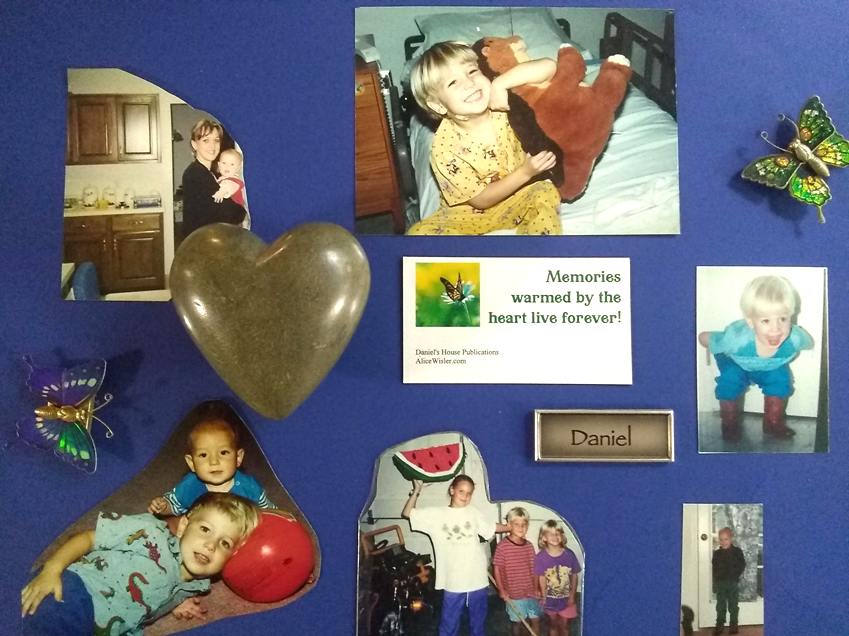
It's those tapes that want to ruin our lives.
When we've lost a loved one, the tapes of the last moments play in our heads like a broken record that never stops its scratchy noise. The music is the worst we've heard---loud and grating. There is no off-button. The noise is made up of our thoughts that cause us to contemplate the last words spoken by ourselves and by our loved one. We think of how it could have gone differently and how if it had, our loved one would still be alive. Over and over we ask, why did it have to end this way? If only . . . . If only I had taken him to the hospital earlier. If only I had watched him more closely. If only I had known more about the disease or his friends or the event where he was in danger. We scream into the night. We think the constant-playing tapes will kill us. Exhausted, we want to shut off our minds.
As we go over in detail the last moments with our loved one, we want to believe the moments could have been orchestrated differently.
Control is the loud tune that plays in rhythm with If Only. The two work together. We have been led to believe that we have control. We think it is ours. We wore our seat belts and ate our vegetables, were kind to our neighbors (even the nosy ones) and bought toys for our children. We shouldn't have to be going through this confusion, this ache, this despair. Our loved one should still be here with us. Instead, we are now living a life without him or her and wondering how to face each day. For whatever reason, we have bought into the myth of power, control, thinking we could play God in our lives. We ignore the soft voice that asks, "Did you get to choose your place of birth, or height, or color of your eyes?"
To try to make sense of our confusion and illusions, we journal. Page after page, we fill them with questions like: How long does this pain last? When will I get back to the old me? For help, we read the lives of others who have been on the bereavement journey. We marvel at their survival and at the same time wonder how they have done it. Can we do it? Can we journey year after year without our child, our spouse, our parent, our friend?
We put the journals and books aside, and go back to the If Only and Control. Over and over the frantic tunes play as we continue to live the last days. While the re-living the last days seems detrimental, the truth is, it is necessary. It's called process. Our brains need to process what has happened to us in our loss. Eventually----and I don't know how long eventually is---the tapes wear thin. We forgive ourselves, we realize control is a myth, we realize it is not up to us to have control over when someone takes his last breath. We acknowledge we are not God. We may never understand why our loved one died when she did or the way she did. We may never get the answers we want on this earth. But one thing we know, until our last breath, we are going to have to figure out how to make this bereavement journey work.
On a day where the sun pushes past the clouds, we hear the laughter of our loved one. As we drive to work, we recall a road trip with our significant other. In the parking lot, we remember a joke our son told. The laughter feels strange to our ears. A smile expresses the memories we carry in our hearts. The next day we may be back to listening to the If Only tapes, but once again, on another day, a fond memory slips through. She did like to bake oatmeal cookies, he did give the best hugs. And we trod on the journey, clouds and sunlight, dreariness with glimpses of hope. And we are progressing. Day after day, we embark on the rocky path, finding our footing, discovering what we need, learning and growing.
And one morning, we find ourselves thinking: Maybe I will survive. Maybe, perhaps, I might even thrive again. And in the meanwhile, we savor the laughter and the love. They are what fit inside our hearts; their tunes are worth carrying and playing over and over again.
Showing posts with label bereaved parents. Show all posts
Tuesday, February 6, 2024
When Love and Laughter Play the Tune
Labels:
Alice J. Wisler,
bereaved parents,
faith,
grief and loss,
healing,
loss of child,
loss of loved one,
loss of parent,
loss of spouse,
weep boldly,
write bravely
Saturday, November 18, 2023
Write Bravely! An All-Day Writing Workshop 2024
So folks, it's been a few years since I've facilitated an all-day writing workshop to help those in grief and loss discover the benefits of writing.
I enjoy these workshops so much, and feel it's time for one to be held in 2024. The plan is to find a venue where we can meet and spend the day together, writing, sharing, and learning. Since I'm in Durham, North Carolina, I'd like to have the event in either Durham or nearby Raleigh or Chapel Hill. The day will start around 9 AM and end by 4 PM. There will be a dive into what grief and writing through it entails, what to write and not write, tips on expressive writing, making your writing the strongest it can be, learning from each other, and silent time to freely write without distractions.
Interested? Email me at awisler3@gmail.com to let me know of your interest and to keep up with the updates as the workshop location is disclosed, etc.
Labels:
Alice J. Wisler,
bereaved parents,
grief and loss writing workshop,
Write Bravely All-Day Writing Workshop
Monday, June 26, 2023
A Little Book that Took a Long While
It's here, it's here, it's here!
My memoir, Life at Daniel's Place, is now in both paperback and e-book! If you've been following my blog posts and newsletters, you will understand the enormity of what has finally transpired. My memoir has had so many starts, stops, epiphanies, and overhauls. Whew!
Can a graveyard ever offer tranquility after turmoil? At first, Alice wants to run from the cemetery because it symbolizes that Daniel, her four-year-old son, is gone. Being at the grave fills her with shame, guilt, and doubt. Gradually, thanks to geese, picnics, helium balloons, and epitaphs, the cemetery, named Daniel’s Place by Alice’s family, becomes a haven of discovery and beauty. Life at Daniel’s Place is the story of a mother’s heart transformed from fear to certainty and confidence. Alice’s reflections remind us that even in trauma, a renewed faith in God is possible and welcomed.
I am so glad that my memoir is now in print and ready for you to read!
I hope you'll get your copy of Life at Daniel's Place: How the cemetery became a sanctuary of discovery and gratitude. You can order from Amazon now.
Thursday, August 4, 2022
The Writing the Heartache Podcast has made her debut!
Do you remember when I did Blogtalk radio segments? No? That's okay; it was a while ago. I had about 12 episodes where I spoke on
grief and the bereavement journey.
Now, after much trepidation, I have joined the podcast world. Writing the Heartache is the theme and has been my push/shove/advice since Daniel died when I realized the wonderful and inexpensive therapy that comes from writing after loss.
My first podcast (Anchor.FM) is short; it will take just over 5 minutes of your day. The topic is: No Grammar or Spelling Worries; Just Get it Out There. I share a few benefits of writing from grief.
You can listen by going to the Anchor.FM page. If you don't have a Spotify account (I don't), you can listen by scrolling down the page and pressing the arrow. Go here.
Now, after much trepidation, I have joined the podcast world. Writing the Heartache is the theme and has been my push/shove/advice since Daniel died when I realized the wonderful and inexpensive therapy that comes from writing after loss.
My first podcast (Anchor.FM) is short; it will take just over 5 minutes of your day. The topic is: No Grammar or Spelling Worries; Just Get it Out There. I share a few benefits of writing from grief.
You can listen by going to the Anchor.FM page. If you don't have a Spotify account (I don't), you can listen by scrolling down the page and pressing the arrow. Go here.
Labels:
Anchor.FM,
bereaved parents,
bereavement,
Christianity,
healing through writing,
No Grammar or Spelling Worries,
Writing the Heartache,
writing to heal
Thursday, October 7, 2021
Every Loss I See
Every death is your death. Every sorrow I come across takes me back. Even the TV moms portrayed as suffering loses of a child cause the wound from your death to ignite. I cry for their loss, their broken story. The actress who does a realistic job of conveying her woe gets more tears from me. I wipe my eyes and think: it never goes away, that ache, that sadness, that loss in losing you, Daniel.
In a recent movie I watched as one of the characters, an older woman, tried to console a young boy of twelve who had lost his baby sister. She said that the child was with Jesus and that Jesus is here. I thought: ah, that's a good way to think. Jesus is with us and he is also with Daniel in Heaven. Jesus bridges the gap between Daniel and me. He is with us both, even if Daniel and I can't be together. As I continued watching the movie, the sweet woman telling that boy to be bolstered by thinking of death in this way made me feel both grateful and sad at the same time.
I suppose that what surprises me most is that even after 24 years I still shed tears unexpectedly.
Every loss I see, every loss I hear, takes me to that place that never fades.
I miss you, Daniel.
I suppose that what surprises me most is that even after 24 years I still shed tears unexpectedly.
Every loss I see, every loss I hear, takes me to that place that never fades.
I miss you, Daniel.
Tuesday, July 13, 2021
Make it Come to Life : Prologue to a memoir
A view from a train window can kick start a fascinating story. Look what it did for Walt Disney. On a journey from Manhattan to Hollywood in 1928, Walt looked out his window as large towns gave way to wheat and corn fields. And there, under an apple tree, Mickey Mouse showed up. Perhaps Mickey waved a white-gloved hand, or maybe he just smiled. Walt captured him on a sketch pad and the stories began. Walt’s gone now, but his cartoon mouse has traveled all over the world and lives forever.
Although I grew up on trains in Osaka, Japan, my creations weren’t the kinds you sketch, but printed words. I looked out the windows and instead of a mouse, four teens appeared on a boat. They needed an ocean to take them to a remote tropical island where they would get lost, build campfires at night, eat mangos the size of footballs, and have fascinating adventures with the natives. I put them in a rowboat (at age eleven I was not the smartest seafarer which meant neither were my characters) and let a storm fester with just enough wind for their vessel to wash against the shoreline of the island. I named the island Blue Hama (I suppose I didn’t have the knack for good names at age eleven either).
Later, when I had crushes on boys with names like Ethan and Harold, I looked out the window as trains took me to and from school, and saw handsome boys on bicycles near parks where they met pretty girls named Belinda, Camithia, and Sylviana. I bought spiral notebooks at the local stationer’s near my home in Awaji, knowing that each notebook would be the place where a best seller would be brought to life and I’d be rich and famous before I turned twenty.
Each train ride from Awaji to Karasuma—the station closest to my international school—took forty-seven minutes. That’s a lot of time to peer out of windows. In the afternoons, the train was less-crowded and when I got to sit down, I lured my characters, bringing them from outside where they began along the tracks, to inside the pages of my notebooks. I gave them words, obstacles to conquer, and lots of love in their hearts.
If Walt and I had ever crossed paths, or if we’d been seated on the same train, he might have used his pencil to draw me as a kid. Two blond ponytails sticking out from just below my ears, plaid skirt, red tights that bagged around my ankles by the time school got out, and a pair of black patent-leather shoes that were magnets for doggy poop. In my hand would be a yellow number 2 pencil sans an eraser on the end because erasers never last the lifetime of pencils. The pencil would be scratching out my messy words (I had what was known back then as sloppy penmanship) over the lined notebook’s pages, and my ears, although not as prominent as Mickey’s, would be stretched to listen for the conductor’s announcement of my train station.
I spent my childhood on trains. And when I wasn’t on one, I was running to catch one or if I missed it, waiting for the next one on the platform.
Every parent has some story they repeat and repeat, passing it onto their offspring. That’s how those tales of suffering get handed down like certain unwanted family heirlooms: “I had to walk to school in the snow.” “I had to walk up hill in the snow both ways.” “I had to walk in the snow both ways with no shoes.” Mine is: “I had to ride the train to school every day for forty-seven minutes. And that was just one way!” And like any other parent, I’m always subject to the indifferent attitudes my children display when my story is told.
When the Amtrak thundered over the track that day in 1996, I no longer rode the train to school. I was a grown woman of 35 with three of my own children. My middle child, Daniel, aged three, was by my side as we watched the silver cars streaked with red, white, and blue. One after another, after another, racing along, going somewhere. We stood, silent, as one does during the singing of the national anthem or during a prayer. The track was just beyond the slide and swings and the shade of the massive oak tree where we’d had a picnic lunch of peanut butter and jelly sandwiches because those are the easiest for moms to make.
The sound of a train has always tugged at the wild hope chord of my heart. A train symbolizes a way toward a happy destination, but more—the actual journey, looking out the window, passing places you’ve never set foot in, capturing vistas that are quaint, majestic, or even spiritual.
Daniel seemed to understand my need for reverence, he paused from playing with Caleb and tickling his baby brother Ben to be captivated with me.
But once the train was out of sight, he left me for the slide. He climbed up the ladder and at the fourth rung, stopped. “Where is the train going?” he asked.
“To the next station.”
But my reply didn’t seem enough for my son. “Where is the next station?”
I know that Moms are supposed to have all the answers, it comes in a kit they hand you at the hospital after delivery, soon after the umbilical cord is cut. Since the park was just miles from the state capital, I offered a guess and said, “Raleigh.”
“The train’s going to Raleigh?”
Why not? “Yeah.”
“Where’s Raleigh?” Daniel asked.
“Oh, about two miles from here.”
Satisfied with my answer, Daniel continued his climb to the top of the slide. From there he lifted a hand from the railing to wave at me. Just as my motherly instincts kicked in, and with them, the familiar phrase that all moms are taught to say, “Be careful!” Daniel said, “Bye, Mommy! I’m going to Raleigh.” And down he slid, his blond hair flying with the speed of an oncoming train. At the base of the slide sat his friend Caleb, whom Daniel managed to only nick with his shoe. “Sorry, Paleb,” Daniel apologized.
Caleb, unalarmed, continued drawing in the sand with two sticks, one in each hand, swirling them around as though stirring a pot of stew.
It was April, a warm and sunny Southern day. Baby Benny played in his stroller, his chubby hands wrapped around a stuffed blue dog, one that Daniel let him borrow. We often came to the IBM Park on clear days because kids and the outdoors are a freeing combination and moms should get away from houses that need cleaning. Everyone is entitled to some kind of liberation. On days when I babysat Caleb so that his mother, Susan, could work on her music duties at our church, he came with us. Susan packed him lunches in brown paper bags—chocolate pudding cups with peel-away lids, fat ham sandwiches, fruit gummies, and homemade cookies.
“You want that? How about this? Paleb, are you gonna eat this?” Daniel would sort through Caleb’s bag, pulling each item out, shaking it in front of his friend’s face, and asking. That which his friend did not want, Daniel, happily indulged.
They tell you in the Mom’s Kit that your children will always prefer the lunch of another child. Something to do with the grass being greener on the other side of the fence, which boils down to other moms are cooler because they know what kids really like. Sometimes, when I encouraged him, Caleb ate his ham sandwiches. Daniel eyed those sandwiches and every bite Caleb took as he solemnly chewed his own peanut butter and jelly. I eyed those sandwiches, too. Mother and son wishing we had a mom like Susan to make us lunch.
About three weeks later, when a train whistle sounded and a freight train clamored past us in the park—oil cars, refrigerated cars, a car with graffiti—Daniel waited until the caboose was only a dot on the landscape. Then, turning to me where I sat on the grass with Benny who was getting sand in between his bare toes, Daniel said, “The train’s going to Raleigh.”
I smiled. “Oh, is it?”
“Yes. Raleigh is the next station.”
Years later—eighteen to be exact—I was seated in my grandma Stubbs’ mauve recliner, one I had inherited after her death. I looked through old photographs, color prints that mark time. It was a parade of matte and glossy visits—Easters with baskets bigger than my children, the Christmas we got the puppy, birthday cakes decorated with thick butter cream icing, our first night in the new house on Monticello—all made their appearances, chronicling the passage of the years. Rachel, Ben and Liz had all walked in and out and back in the new house many times again and again, even the puppy that grew into a senile beagle, made her way through and out the doggie door. But there would be one person who would never walk through the laundry room door inside or out. No one would ever see his smile or hear his laughter. He was gone, and yet he was everywhere. He was in every story we remembered and told.
The afternoon in my living room of remembering gave into the evening. Through the winter stillness, a train whistle sang—low, mellow, permeating the air. I didn’t stand, but my whole being was attentive until the song turned into only a murmur, as I envisioned its journey down the familiar tracks, tracks I could not see, but knew too well.
“Where is it going?”
Oh, Daniel, you know.
“The train’s going to Raleigh.”
And back again. And even beyond. There is so much to be discovered.
The story was already there, I just had to find the best way to make it come to life.
Although I grew up on trains in Osaka, Japan, my creations weren’t the kinds you sketch, but printed words. I looked out the windows and instead of a mouse, four teens appeared on a boat. They needed an ocean to take them to a remote tropical island where they would get lost, build campfires at night, eat mangos the size of footballs, and have fascinating adventures with the natives. I put them in a rowboat (at age eleven I was not the smartest seafarer which meant neither were my characters) and let a storm fester with just enough wind for their vessel to wash against the shoreline of the island. I named the island Blue Hama (I suppose I didn’t have the knack for good names at age eleven either).
Later, when I had crushes on boys with names like Ethan and Harold, I looked out the window as trains took me to and from school, and saw handsome boys on bicycles near parks where they met pretty girls named Belinda, Camithia, and Sylviana. I bought spiral notebooks at the local stationer’s near my home in Awaji, knowing that each notebook would be the place where a best seller would be brought to life and I’d be rich and famous before I turned twenty.
Each train ride from Awaji to Karasuma—the station closest to my international school—took forty-seven minutes. That’s a lot of time to peer out of windows. In the afternoons, the train was less-crowded and when I got to sit down, I lured my characters, bringing them from outside where they began along the tracks, to inside the pages of my notebooks. I gave them words, obstacles to conquer, and lots of love in their hearts.
If Walt and I had ever crossed paths, or if we’d been seated on the same train, he might have used his pencil to draw me as a kid. Two blond ponytails sticking out from just below my ears, plaid skirt, red tights that bagged around my ankles by the time school got out, and a pair of black patent-leather shoes that were magnets for doggy poop. In my hand would be a yellow number 2 pencil sans an eraser on the end because erasers never last the lifetime of pencils. The pencil would be scratching out my messy words (I had what was known back then as sloppy penmanship) over the lined notebook’s pages, and my ears, although not as prominent as Mickey’s, would be stretched to listen for the conductor’s announcement of my train station.
I spent my childhood on trains. And when I wasn’t on one, I was running to catch one or if I missed it, waiting for the next one on the platform.
Every parent has some story they repeat and repeat, passing it onto their offspring. That’s how those tales of suffering get handed down like certain unwanted family heirlooms: “I had to walk to school in the snow.” “I had to walk up hill in the snow both ways.” “I had to walk in the snow both ways with no shoes.” Mine is: “I had to ride the train to school every day for forty-seven minutes. And that was just one way!” And like any other parent, I’m always subject to the indifferent attitudes my children display when my story is told.
When the Amtrak thundered over the track that day in 1996, I no longer rode the train to school. I was a grown woman of 35 with three of my own children. My middle child, Daniel, aged three, was by my side as we watched the silver cars streaked with red, white, and blue. One after another, after another, racing along, going somewhere. We stood, silent, as one does during the singing of the national anthem or during a prayer. The track was just beyond the slide and swings and the shade of the massive oak tree where we’d had a picnic lunch of peanut butter and jelly sandwiches because those are the easiest for moms to make.
The sound of a train has always tugged at the wild hope chord of my heart. A train symbolizes a way toward a happy destination, but more—the actual journey, looking out the window, passing places you’ve never set foot in, capturing vistas that are quaint, majestic, or even spiritual.
Daniel seemed to understand my need for reverence, he paused from playing with Caleb and tickling his baby brother Ben to be captivated with me.
But once the train was out of sight, he left me for the slide. He climbed up the ladder and at the fourth rung, stopped. “Where is the train going?” he asked.
“To the next station.”
But my reply didn’t seem enough for my son. “Where is the next station?”
I know that Moms are supposed to have all the answers, it comes in a kit they hand you at the hospital after delivery, soon after the umbilical cord is cut. Since the park was just miles from the state capital, I offered a guess and said, “Raleigh.”
“The train’s going to Raleigh?”
Why not? “Yeah.”
“Where’s Raleigh?” Daniel asked.
“Oh, about two miles from here.”
Satisfied with my answer, Daniel continued his climb to the top of the slide. From there he lifted a hand from the railing to wave at me. Just as my motherly instincts kicked in, and with them, the familiar phrase that all moms are taught to say, “Be careful!” Daniel said, “Bye, Mommy! I’m going to Raleigh.” And down he slid, his blond hair flying with the speed of an oncoming train. At the base of the slide sat his friend Caleb, whom Daniel managed to only nick with his shoe. “Sorry, Paleb,” Daniel apologized.
Caleb, unalarmed, continued drawing in the sand with two sticks, one in each hand, swirling them around as though stirring a pot of stew.
It was April, a warm and sunny Southern day. Baby Benny played in his stroller, his chubby hands wrapped around a stuffed blue dog, one that Daniel let him borrow. We often came to the IBM Park on clear days because kids and the outdoors are a freeing combination and moms should get away from houses that need cleaning. Everyone is entitled to some kind of liberation. On days when I babysat Caleb so that his mother, Susan, could work on her music duties at our church, he came with us. Susan packed him lunches in brown paper bags—chocolate pudding cups with peel-away lids, fat ham sandwiches, fruit gummies, and homemade cookies.
“You want that? How about this? Paleb, are you gonna eat this?” Daniel would sort through Caleb’s bag, pulling each item out, shaking it in front of his friend’s face, and asking. That which his friend did not want, Daniel, happily indulged.
They tell you in the Mom’s Kit that your children will always prefer the lunch of another child. Something to do with the grass being greener on the other side of the fence, which boils down to other moms are cooler because they know what kids really like. Sometimes, when I encouraged him, Caleb ate his ham sandwiches. Daniel eyed those sandwiches and every bite Caleb took as he solemnly chewed his own peanut butter and jelly. I eyed those sandwiches, too. Mother and son wishing we had a mom like Susan to make us lunch.
About three weeks later, when a train whistle sounded and a freight train clamored past us in the park—oil cars, refrigerated cars, a car with graffiti—Daniel waited until the caboose was only a dot on the landscape. Then, turning to me where I sat on the grass with Benny who was getting sand in between his bare toes, Daniel said, “The train’s going to Raleigh.”
I smiled. “Oh, is it?”
“Yes. Raleigh is the next station.”
Years later—eighteen to be exact—I was seated in my grandma Stubbs’ mauve recliner, one I had inherited after her death. I looked through old photographs, color prints that mark time. It was a parade of matte and glossy visits—Easters with baskets bigger than my children, the Christmas we got the puppy, birthday cakes decorated with thick butter cream icing, our first night in the new house on Monticello—all made their appearances, chronicling the passage of the years. Rachel, Ben and Liz had all walked in and out and back in the new house many times again and again, even the puppy that grew into a senile beagle, made her way through and out the doggie door. But there would be one person who would never walk through the laundry room door inside or out. No one would ever see his smile or hear his laughter. He was gone, and yet he was everywhere. He was in every story we remembered and told.
The afternoon in my living room of remembering gave into the evening. Through the winter stillness, a train whistle sang—low, mellow, permeating the air. I didn’t stand, but my whole being was attentive until the song turned into only a murmur, as I envisioned its journey down the familiar tracks, tracks I could not see, but knew too well.
“Where is it going?”
Oh, Daniel, you know.
“The train’s going to Raleigh.”
And back again. And even beyond. There is so much to be discovered.
The story was already there, I just had to find the best way to make it come to life.
Labels:
a mother's grief,
bereaved parents,
cancer death,
commuter trains,
Daniel Paul Wisler,
Japan,
memoir writing,
Mickey Mouse
Tuesday, May 19, 2020
During Coronavirus Embrace Now
My son Daniel stands at the shore of the Atlantic Ocean with his arms spread behind his back and smiles into the June sun.
With beaches closed due to the Coronavirus, this is not a recent event. It was over two decades ago when we went to the beach as a family and I took the photo that I have since placed into a burnt-maroon frame. When I kiss his face though the acrylic, I know that many see the photo as a three-year-old boy enjoying a day at the beach. But it symbolizes more for me. It’s a reminder to live every day as though it is all you have.
When the photo was taken, our family was trying to do something familiar in a time when nothing felt normal. Less than two weeks earlier we’d been told the tumor in Daniel’s neck was malignant. My son went through tests, two surgeries—one to implant a double-lumen catheter— and a week of chemo. He lost his hair on the trip to the beach; it came out in clumps on the van’s back seat. “It’s sad, isn’t it?” his five-year-old sister said. “Isn’t it just so sad?”
Just the other day during the Coronavirus lockdown, we celebrated my youngest child’s 23rd birthday. Our family tradition is to go to Red Robin for birthday dinners. This week we had to adapt to something new. At a table in front of the restaurant, my husband, wearing a face mask, ordered our meals. We waited in our cars until the waitress signaled our food was ready. With meals in tow, my three kids and my eldest’s boyfriend, my husband and I, drove in our cars to a vacant parking lot in the shopping complex. I sat on a towel on the curb to eat my salad. The others sat and stood at socially-acceptable distances and consumed burgers and fries.
It was wonderful to see my adult children and hear their stories of how they are coping and adjusting to this season of strange. The restaurant where Ben worked closed, so he was laid off in March. The birthday daughter, Liz, teaches her high school students online. My daughter Rachel and her boyfriend have had an uptick in their home repair and remodeling business. “People are looking at the homes they’re in all day and see what needs to be improved,” the boyfriend said.
After we ate, we sang happy birthday. We played music on my husband’s phone and my daughters danced the Macarena. As the sun set and we said our good-byes, giving each other virtual hugs, I smiled. This was by no means an ideal dinner out, but it was all we had.
As we parted, I didn’t say, “Next year it will be better.” I did not add, “Next year we can be back inside Red Robin and enjoy a meal around a table with chairs.” I didn’t voice any of that because I do not know what next year will hold. Days before Christmas 1996, Daniel spiked a fever and we took him to the emergency room. We spent Christmas day in the hospital with him. “Next Christmas,” I said as we ate ham from the hospital cafeteria, “he’ll be finished with his protocol. We’ll all be home for Christmas then. We’ll be a normal family again.”
Daniel’s death crushed the hope that the following Christmas would be better. He contracted a staph infection at the end of January and died in February. His absence is a hole in our hearts.
In the photo at the beach, Daniel wears a cap to cover his bald head. His hands are full of sand and shells. He’s standing by the fierce waves but he looks the other way, in the direction of the sun, that smile on his face. My boy is not fearful. His expression shows that he’s happy to be at a place he loves with his family.
In the midst of lockdown we may think we want this isolation to end and for things to get back to normal. Yet the days in shelter-in-place hold value. We’ve traded a day of our lives for each one. For better or worse, nothing will be the same again. You might think things are difficult, but take a look at what you do have whether it is children, a spouse, friends, or parents. Maybe you are lucky enough to have them all, even if they are miles away.
Here and now, this is the time to stand with your arms spread out, your hands filled with life and smile into the sun.
Another bereaved parent said it best."Life is short, break the rules [but I bet he’d expect us to follow the COVID-19 regulations], forgive quickly, kiss slowly, love truly, laugh uncontrollably, and never regret anything that made you smile.” (Mark Twain)
Tuesday, February 4, 2020
Our Memories Fill the Stars
When a loved one dies, all we have left are memories. While the memories are sweet, they are never enough. We wish for more.
When my son Daniel died, I felt cheated that I had only four years of life with him. But after the horrific pain subsided, slowly, I was able to think of the happy memories I could hold onto and carry with me.
I'm no artist, but I did go to Michael's many times to find items I could paint or decorate that connected me to my son. On one trip to the arts and craft store, I got a plain basket and some paint. I also picked up wooden objects from various bins. These were already cut and painted, which was great since I don't think I could draw a boy in a blue-striped shirt to save my life. Daniel had blond hair and a blue-striped shirt, so that made me pick that wooden piece up and put it in my shopping cart. I got a boot because he had cowboy boots and a pig because he once fell on a prized pig at a petting zoo and the pig bit him. (Security contacted the owner of the pig, but he never showed up.) I also picked out a watermelon slice because there are many stories about Daniel revolved around that juicy red and green delight.
I painted the box with gold, red, and blue. I managed to paint a few yellow stars, too. I wrote on the lid: Our Memories Fill the Stars. The quote is one I came up when I stood under a velvet sky and watched the distant stars. I cushioned the inside of the memory basket with a red bandana that Daniel was given at a Make a Wish event the last autumn of his life.
Each wooden object holds a precious memory. My memory basket gives me a way to take out the pieces, touch them, smile, and remember.
At first when Daniel died, I thought he wouldn't be remembered by many. His friends were only four and five years old. Perhaps adults would keep his memory alive, but I couldn't be sure. At his grave, I promised that I'd tell Daniel stories. Over the years (there have been 23) I've discovered that no one can steal the memories. They are life-giving and connect me to the Daniel I love and miss every day. While I have had to struggle (immensely) with the events that surrounded his demise and death, I don't cultivate those memories. I've learned not to dwell on the treatments for cancer he went through and the shock of his passing.
Those of us who have lost a loved one discover how to recycle the memories that bring sunlight. We tell the stories again and again, and each time, we feel the boldness that lets us know it's not only okay, but acceptable, to talk about our beloved child. No one should try to shut us up. Our child died, but he also lived!
May the memories we choose bring joy today and always.
Labels:
a mother's grief,
Alice J. Wisler,
bereaved parents,
grief,
loss,
memorials,
memory basket,
Memory box
Thursday, May 9, 2019
The Hand of a Preschooler: Mother's Day Reflection
It happens; things are moved, hidden items appear. I think that's some sort of law of nature. If it's moving a dresser to fit another piece of furniture into the room, what appears might be as nondescript as a couple of dust bunnies. You haul out the vacuum cleaner and let the evacuation begin. Run the Hoover over the spot and a dust-free carpet emerges. But if it's a tender memory that has been hiding, well, then, you bring out the tissues.
When Carl and I got a new king mattress and bed, we had to move the highboy dresser to make room. I expected dust. Dust and I are old pals, and I think she really likes me because I let her hang around, sometimes for weeks.
But it was what I didn't expect that got me emotional. There, along with the dust behind the dresser, was a Mother's Day card. Not only was it brittle with a rip in it, but it was from my son Daniel who died in 1997.
Wow.
On the light blue faded paper were his hand prints, a glitter heart, a heart in marker, and a few other squiggly lines, the kind preschoolers draw that hold hidden meaning no one else knows about. His teacher must have written the words for him: Happy Mother's Day, Love, Daniel. I wondered when this was created, perhaps something he had done in Sunday school the Mother's Day he was three. His last Mother's Day to give me a gift.
These are the kinds of things that you are relieved to find: Lost keys, eye glasses, a check for a nice sum of money. Finding a card from a child who has been gone from you for over twenty years falls into a whole different category. You aren't relieved because it wasn't lost. You are grateful. And a feeling of sacredness falls over you. The discovery of something he created is a sacred love letter that shouts out again and again: He lived! And he loved.
I suppose I placed the Mother's Day card behind the dresser when I first moved to the house. Probably with the intention to do something with it. Most likely thinking I'd find a real place for it. One day. And one day turned into fifteen years because you know, out of sight, out of mind.
I ran a finger over the two hand prints on the card. Right-handed prints. Daniel was left-handed. But in the hospital it was his right hand that I held that night he was having trouble getting to sleep.
"Mommy, where's your hand?"
I was in the chair bed next to his hospital bed. And he reached over the railing of his bed for my hand, I gave him mine. Holding hands against a cold hard railing got uncomfortable. When I thought he was asleep, I pried my fingers from his.
He wasn't asleep. "Mommy!" His tone was accusatory. "Mommy, where's your hand?!"
"Here it is." I put my hand out for him to grab.
And he did, clinging to it until, at last, he fell asleep.
That right hand was the same hand I held when we walked across the mile-high bridge at Grandfather Mountain. He was three, nine months before he was diagnosed with cancer. The bridge swayed in the wind. Daniel held tightly to my hand, not because he was afraid, but because I was. We walked together all the way to the other side. I wasn't sure I would make it. Frightened by heights and feeling paralyzed, I thought I'd wind up as the only person to need a helicopter to pull me off the bridge. When Daniel and I got to the safety of the other side and off the bridge, I almost kissed the ground.
This Mother's Day I'm grateful for memories and soft tissues. I've found over the years that emotions are never far, and sometimes they still surprise.
Happy Mother's Day to all the bereaved mamas out there who'd covet and treasure one last time to hold the hand of a son or daughter. May you find those gentle memories. Hold them close and remember.
And Daniel, thanks for the love.
Labels:
a mother's grief,
bereaved parents,
cancer patient,
Childhood cancer,
Daniel Paul Wisler,
Grief and Mother's Day,
Mother's Day gifts
Friday, August 10, 2018
Seeing Your Child's Name
When I showed my friend Jane the plaques we made for her daughter's memorial garden, she loved them. Carl does the work, so I took no credit, except I did screw in the eye hooks and attached the chain to one of them. You would think I was constructing a new house; it took me much longer than it would have taken an average person to do that task of placing the eye hooks, drilling the hole, screwing them in. But enough about my lack of skill and slowness. What impressed me and will stick with me about giving the two garden plaques to Jane was what she said after she said she loved them.
"It's so nice to see her name."
A name. Katelyn. When Katelyn was born, Jane came up with the spelling of the name, so not only was it her daughter's name, Jane had a part in crafting it.
In the bereaved parents' writing workshops I facilitate, I often have parents say their child's name aloud. All together we say our child's name, like one big burst of sunlight. Sometimes we go around the room and take turns saying the name of our child. It's a sacred time.
Whenever we get an order at our shop, Carved By Heart, and the buyer has the name Daniel, I love seeing it on the order form. My heart does a little flip. This customer is special to me because of his name. It doens't matter than I don't know the customer personally, I just love seeing his name. After the item is created and I've wrapped it up, I get to write Daniel on the package. My son's name. My son who is no longer here.
So when Jane ran her fingers over her daughter's engraved name and smiled, it was a powerful moment.
We do need to see and speak our child's name. Often. We don't get to call them to dinner anymore, watch them play, or wrap a gift for them. But we can give ourselves a gift by saying his/her name. Aloud. We can have it engraved into pine and see it, too. Our new butterfly garden plaques are now at our shop on Etsy.
Labels:
bereaved parents,
Carved By Heart,
Etsy,
garden decor,
Garden Plaque,
memorials,
Our child's name,
Personalized garden plaque
Friday, March 9, 2018
Growing into Your Grief: Owning It and Living It
You have to grow into your grief. No one can tell you how to do it.
At first after Daniel died, I was going from one train of thought to another. Is this me? Is this what I believe? Is this what I think? Is this what grief is to me? I wasn’t sure how I was to be as a grieving Christian. Some told me to be happy that Daniel was safe in Heaven with Jesus. Did that phrase comfort me? Others said that our children are only on loan from God. Did that mean I should have realized that my other children could be gone from me at any moment, that they have a Due Back By date stamped on them?
I fluctuated between the ideas and concepts many held at my local chapter of The Compassionate Friends and those of the church. Sometimes these concepts about God were at odds: God didn’t allow Daniel to die; it was a work of the Devil. God allows bad things to happen. God has our days numbered. God has no control over when a person dies. God does not take away our suffering, but he walks with us in it.
As I tumbled into grief’s pit, all of these concepts/truths/thoughts/ponderings made me dizzy.
What did I believe? What did I need in order to make sense of Daniel’s death and get through the muddling? And the most daunting question: Who was I now?
Over the years, you grow into grief, like a new skin. At first, you don’t know where you stand or how to adjust to the “skin” until time passes—time where you’ve sufficiently grappled. During the grappling stage, your thoughts bounce around: I don’t like this new skin. I want my old life back. Where is God? What will I do? What works for me? Why is this skin so itchy? I miss my child.
It’s a time of insecurity, this early grief. But then, you slowly come into knowing who you are—who you have become, shaped by grief. You know which platitudes bug you and why they do. You understand that half of the things society says about moving on are just to make others feel comfortable in their discomfort. People are scared and trying to make sense out of your tragedy. You represent to them that not only did your child die, but that theirs can, too. Quickly, or from an illness that goes on for months. You recognize when you need to leave a function because you’re tired of superficial conversations. You do say your deceased child’s name and don’t feel the need to apologize for bringing up the dead. Or for sharing about the time he slid down the snowy bank in a recycle bin.
Over the years, you have worked hard. Now you have a time-tested grief. You own it. You know exactly what this grief is because it is part of you. You don’t settle for what others expect grief to be for you. If you want to go to the cemetery and lift balloons to Heaven, you do it. You make no excuses. You live your grief out loud in its fullest which sounds ironic and crazy, but that’s how grief has to be lived.
You know that when a school shooting happens and the news anchor says two days later, “They are still grieving,” that he doesn’t get it. Because any parent who wears the itchy skin of grief knows that using the word still is almost laughable. Still grieving after two days, really? You want to be that news anchor for a moment and tell the viewers this: These students, teachers and parents will grieve these losses for the rest of their lives. They have just begun the journey of growing into grief.
Monday, August 21, 2017
Watermelon, Irises, Tomatoes, Geraniums, and a Spider: Does Time Heal Wounds?
In bereavement meetings parents have certain topics that continue to be discussed. One's about time and wounds. A mother who had lost her daughter to a car accident just weeks before my son died, said to the group, "They say that time heals all wounds." She was southern and I couldn't understand if she was saying "all wounds" or "old wounds".
I suppose the question that I wanted to ask was: Does time heal? At all? As the minutes, hours, and days tick away in agony, do all wounds get taken care of, soothed, do the scabs heal, do the ugly scars fade?
As a newly-grieving mom, I knew so little about the journey I had been forced to take, but I did know one thing, and that was that old scars do not fade away. I've had a scar since I was two, a paintbrush I was playing with in the bathtub attacked me and cut the skin near my left eye. My parents wrapped me in a towel, held me while I cried, felt awful, and later would wonder if they should have taken me to get stitches. The blood dried up, and healing started, but that scar is still visible all these years later.
So time doesn't heal old wounds. I suspect that after 54 years, that scar on the corner of my eye has done all the healing it is going to do.
No wonder I resonated with another bereaved mother, a veteran, who at fifteen years since her son took his own life, said to me over lunch one afternoon years ago, "I think I've done all the healing that I'm going to do."
She wasn't giving up on healing or digging a hole and hiding, she was being realistic. There comes a point in the bereaved parent's life when she or he knows that it is not going to get any better than this.
For me, I'm not going to be able to look at the things that remind me of Daniel and not feel that tenderness in my heart. Since his death, two fruits, two flowers, and one spider have kept me in the loop of significant memories. The watermelon, the geranium, the tomato, the iris, and the spider are some of the things that hold powerful remembrances for me. And depending on the time of year (Christmas, Daniel's birthdate in August or death date in February), if I encounter any of these, well, bring on the Puffs.
Society may think time washes it all away like an ocean wave. Build a sand castle at the beach and once the waves knock it down, there is no evidence that a sandcastle once stood in the spot. Many can't believe that after ten, fifteen, or twenty years a mother or father can still feel pain.
But it's not that our desire is to feel pain, it's that we want to remember and since our child is dead, of course, it's always going to make us sad.
When I see a purple iris blooming in my garden, I recall the time Daniel, at age three, couldn't say my name Alice well enough to be understood by strangers and they thought he was saying, "My mommy's name is Iris."
Daniel picked green tomatoes from our garden, even though I told him to wait till they ripened. He took a green tomato to the hospital once and put it on the window sill of his room. He had seen me place green tomatoes on the kitchen window sill at our home, with the hope that the sun would stream in and turn them red.
There are many watermelon stories, including the one where friends brought a watermelon to Daniel when he was in the hospital for chemo treatments on the Fourth of July. He ate a few slices, spit seeds (this was back when all watermelon had "spittable" black seeds), and then said, "I think I've had enough watermelon," and stored the leftovers in the bathtub.
One afternoon I heard Daniel chanting, "A spider, a spider for a pet, a spider for a pet," and when I found him, he was outside watching a tiny spider creep along the side of our house.
And then the geraniums. I would have forgotten about these flowers (and that apparently I was once able to keep flowers alive) if it weren't for the photo of Daniel seated in his blue plastic chair in front of a table with a cup of juice and a blue bowl of food. He chose to eat his lunch outside beside the potted red, pink, and white geraniums. He would have preferred to be naked if I didn't make him wear clothes. When I took that photo, I had no idea that the neck he exposed so nicely held a malignant tumor, one that would surface months later, and change his life and ours forever.
So does time heal old wounds, or even all of them?
No, and for me, that's a good thing.
[Daniel Paul Wisler, August 25, 1992---February 2, 1997]
Thursday, February 16, 2017
Twenty Years of Keeping On
When Daniel died in 1997, my pain was bigger than God. People would tell me that with time it would ease, or that they knew how I felt because they had a cat die and how awful that was.
"Just think," she said as I clutched the receiver, "God needed another flower in his garden and he picked Daniel."
After a few days, when the phone rang and her voice came on the answering machine, I didn’t pick up.
I washed dishes, fed Benjamin apples and bananas, read him stories, and when he was watching Sesame Street, I'd sneak upstairs into Daniel’s room. I’d breathe in the familiar smells it had accumulated: hospital soap, bandages, iodine. But the strongest scent of all was my hollow loneliness. It grabbed me in the gut and pulled me to the floor. Often I would let myself cry.
And that woman would keep calling to offer her words.
But I didn’t return her calls. I felt that since my pain was so large and consuming and I was six months pregnant that she would understand that I didn’t have the energy to call her back.
Eventually she stopped calling me.
And I became grateful for answering machines because they were like secretaries, weeding out the calls I was unable to take. Sometimes friends would call and I would stand by the phone and not answer. I let their voices be recorded and that made me feel that I had some control of my vacant life. I had a choice—to answer or not to answer. I grew more fond of the not to answer.
There were times I thought I was ready for Butner, the psychiatric facility off of I-85. I could walk outside and almost smell the sheets.
I went to support group meetings with other people who would just break into tears, unable to finish sentences, people with ragged photos of their children that they shared so that the rest of us could say, "She is beautiful," even though the child had ears that protruded and was cross-eyed and her dress was too short or too long or too pink. It didn’t matter because eventually I knew I belonged with these people.
I belonged to these parents, who introduced me to words I had never been allowed to say. Angry adults who taught me you can say damn, shit and hell in the same sentence and not be struck down or turned into a pillar of salt. We sat around tables that were much too small to hold our grief and took turns saying our dead child’s name.
I seemed to go on and on with all the medical procedures about how Daniel had been diagnosed with a malignant tumor in his neck and how he’d been through chemo and surgeries and radiation and how a staph infection entered his body. I had had little medical jargon in my vocabulary prior to his diagnosis and death and at these meetings I was using all I had learned. I had no idea how long or short my turn was supposed to be I just knew that I had to tell my story. I had to get it out.
Part of me hoped that as I talked, one of the bereaved parents would stop me and see that I had talked my way out of this horrible story and say, "Oh, no, he couldn’t have died from that, that isn’t medically possible. Go home, your son is surely still alive. Go home now."
And I’d leave the claustrophobic church basement and drive the 40 minutes down Glenwood Avenue to my home and sure enough, there Daniel would be sitting in front of TV watching The Three Stooges with David. And I’d be so excited and happy that I wouldn’t complain that it was 10 o’clock and that David should have already put Daniel to bed.
But even though I attended those meetings twice a month for two years, Daniel never came back. No loop hole in his death was discovered. And pretty soon my heart knew what my head did, my son was gone from this earth and I was going to have to live the rest of my life without ever holding his hand again.
I would write poems at the graveside and lift balloons into the air. I'd cry with other parents, speak at conferences, and raise my three other children and never know why Daniel didn’t get to be a hero and pull through the whole ordeal.
And I was going to have to adapt and adjust just like countless parents before me and just like thousands of parents would have to learn to do after me.
I was in this club that no one wanted to be part of, a club with rituals that no one understood except for the people in it, and a club that had no membership expiration date. Until you die. I would be thirty-seven, thirty-eight, forty, fifty, fifty-nine, gray, old, still showing dampened photos of a little boy who never grew up.
Sometimes when I’d be driving to the meetings, I’d think, what if I just rammed into the Mayflower truck in the lane ahead of me or just gunned the engine and took a leap off a cliff and died. What if . . . ? But then I knew I couldn’t do that to my kids, especially not to the baby because she was brand new and Daniel had told me when she was still in the womb the size of a raisin, and then even larger than that, giving me heartburn and kicking, that I was to take care of her.
So I’d follow the speed limit and take my eyes away from the Mayflower truck and keep going on.
For twenty years I've been keeping on. Truth be told, it is either to keep going on or to roll up and die.
I choose life. And I'm glad I did, and glad I do.
"Will I ever want to laugh again?" a young newly-bereaved mom asked me at a conference where I gave a writing workshop.
"Yes," I replied. "You will be able to laugh again. Trust me. And keep on. You can do it. Where there is breath, this is hope."
"My friends don't understand," she said as she blew her nose into a tissue. "One calls me every week to tell me to get on with life."
"Do you have an answering machine?" I asked and then realized that we are in the twenty-first century. Quickly, I said," You don't have to answer your cell phone every time it rings, you know."
She nodded. "I think I can do that."
But she's doubtful, I can tell by the hollowness in her eyes. I tell her I was there once, just as she is. Wondering, aching, unsure if I wanted to live or ram into the Mayflower truck.
She hugs me and we wipe our eyes.
I think she'll make it.
Many of us have.
For twenty years I've been keeping on. Truth be told, it is either to keep going on or to roll up and die.
I choose life. And I'm glad I did, and glad I do.
"Will I ever want to laugh again?" a young newly-bereaved mom asked me at a conference where I gave a writing workshop.
"Yes," I replied. "You will be able to laugh again. Trust me. And keep on. You can do it. Where there is breath, this is hope."
"My friends don't understand," she said as she blew her nose into a tissue. "One calls me every week to tell me to get on with life."
"Do you have an answering machine?" I asked and then realized that we are in the twenty-first century. Quickly, I said," You don't have to answer your cell phone every time it rings, you know."
She nodded. "I think I can do that."
But she's doubtful, I can tell by the hollowness in her eyes. I tell her I was there once, just as she is. Wondering, aching, unsure if I wanted to live or ram into the Mayflower truck.
She hugs me and we wipe our eyes.
I think she'll make it.
Many of us have.
Labels:
bereaved parents,
Bereaved Parents/USA,
bereavement,
Childhood cancer,
death of child,
remembrances,
The Compassionate Friends
Wednesday, September 2, 2015
Fellow Grievers, be that advocate!
When an appendage is removed from a person, a lot of adjusting has to take place. After the surgery and sutures heal, sometimes physical therapy is needed. The patient has to learn to adapt without a finger or arm or leg. Eventually, a new lifestyle is mastered.
As parents with children removed from us through death, we have to learn a new lifestyle, too. We adapt. We adjust. We cope. But some days we cry and wonder why the world seems to want to shut us out.
There is no way that a parent who has not lost a child to death will ever understand the pain, the agony of absence, and the multitude of emotions that are attached to living without a son or daughter. It's just impossible. I've never lost a limb (in the real physical sense) and I would never pretend to understand my friend Stella, who lost both legs when she was hit by a car.
Yet other parents feel the need to act like they get our pain. They sit with their healthy children surrounding them and tell us not to be so sad. "It'll get better." "You'll be okay." "He's in a better place."
You want to fight back and tell these parents that they don't get it. But instead of trying to get them to understand your grief, there are more dynamic ways you can choose to spend your time. Educate. Be an adcocate. Teach others in a way that they might be able to comprehend. Share with them how they can help you to make the world a better place.
Did your child die from an overdose? What leads to a life where one might die in this manner? What misconceptions do people have about teens and drug usage? Become an advocate for better awareness in this arena.
My son Daniel died from cancer treatments at age four. September is National Childhood Cancer Awareness Month, a month when I reach out via social media to let others know that kids can get malignant tumors. Kids can be born with cancer from no fault of their own or from their parents'. And yes, little children do die from cancer. Parents are empathetic in helping me get the word out because they realize that cancer shows no mercy to age, color of skin, or socio-economic ranks. If they are realistic, they know that any child can get cancer, just as any child is capable of dying from any disease or sudden accident.
I''ve written articles for magazines and newspapers about what striving for a cure means to me as a mom whose three-year-old was diagnosed with neuroblastoma, and what it means to thousands of parents across the country. I wear the gold ribbon as a visual to show my desire to fight for better clinical trials and for a cure for childhood cancer. And I think of my sweet bald-headed Daniel who called himself a Brave Cookie.
Find your place of passion and let others know about it. Use your energy, be fueled by it, even if it stems initially from angst at others' ignorance. Be that advocate in your child's memory! Let your lifestyle be one that encompasses the need for change.
Labels:
advocacy,
Alice J. Wisler,
bereaved parents,
cancer death,
Childhood cancer,
grief and loss,
loss of child,
National Childhood Cancer Awareness Month
Monday, August 24, 2015
One Tough Mama
"You are Wonder Woman. You know that, don't you?" The nurse in the recovery room kept her eyes on a drowsy Daniel but I knew that she was addressing me.
Me, the mom with an eleven-month-old son in a stroller, a child of unknown gender in my belly, and four-year-old Daniel in the hospital bed, about to wake up from his third radiation treatment.
I only smiled.
"One tough mama," she said. "You are amazing."
My daughter would have smiled at me had she been in the room, but she was in first grade learning to write about her brother Daniel. He and I like to red funny books. He has a boo-boo in his neck.
Daniel opened his eyes and looked around the room. "I had a nice nap," he said.
The nurse and I laughed.
This scene is only a memory now, a memory I have recalled over the eighteen years.
Eighteen years ago I did not think that I was a wonder woman. I was merely doing what any mom with a kid with cancer would do----one foot in front of the other, moving forward. It was a season of getting my three kids to where they needed to be when they needed to be there. For Daniel that meant getting him to radiation treatments every day at 6 AM for three weeks, and to the hospital once a month for week-long cancer treatments.
Tears? No. Sentiment? Who had time for that? I was one tough mama.
Eighteen years ago I was thirty-six, and believed that if you prayed hard enough and dreamed big enough, you would never have to live a life of heartache.
When Daniel died at age four, people told me that they didn't know how I did it. They used words like brave and strong and inspiring.
But now I wonder if they would understand that eighteen years since my little boy's body could no longer fight the battle, I'm a crumbling mess. I cry because at The Home Depot a tool set has been reduced to 1992, the year Daniel was born. There's a car in the parking lot with Dan on the license plate.
Days before my Daniel's birthday (he would be 23 August 25th), I am reduced to an ache so large that I wonder if the years have stitched up my wound at all. I recall his death and his birth and the four tiny years between the two events as I prepare dinner for the living.
My kids don't mind tears in the sauce. But they also know that I won't become sad when they head off to college or leave home for a dingy house with a group of boys before completing high school. They know I value the "normal" things kids get to do as they grow older and find their paths. I cherish them and that they get to grow up, fall down, get up, and try again. (And am grateful that the middle child did graduate eventually.)
This is who I am, this is the life of one tough mama.
Labels:
a mother's grief,
Alice J. Wisler,
bereaved parents,
Childhood cancer,
grief and birthdays,
grief and loss
Wednesday, September 10, 2014
Because we remember always
One of the reasons we are Carved By Heart is because we treasure memories. Memories----happy, silly, fun, tender and sometimes tearful---live in our hearts. We have lost a great love, but we have not lost love. Our loved for those no longer here on earth with us is forever present. I know that my memories of my son Daniel are always ready for me to recall and sometimes, even after nearly 18 years, I can still feel his four-year-old fingers in my hand.
Candles are a great symbol of remembrance. Candles offer a wonderful glow, a light to let us know that our loved one's light lives on.
Taking an unscented white pillar candle, we have embellished it with strips of white and purple ribbon. To personalize, we've added a label with a loved one's name. We've carved the name into a wooden stand with a carved dark brown border. There's an indentation for the candle. And then, we've included a silver photo frame. As a final touch, we've added a wooden heart, painted it in silver and glitter. Under the name, we've added a tiny silver charm.
Our remembrance candles burn bright in memory of our loved ones.
See more photos of our candles here at this link. We are happy to personalize a candle and stand/holder for you.
Labels:
bereaved parents,
Carved By Heart,
grief and birthdays,
grief and loss,
in memory,
National Children's Memorial Day,
remembrance candles
Subscribe to:
Posts (Atom)